
Matthew 6:33: Seek First the Kingdom of God and His Righteousness
But seek first the kingdom of God and His righteousness, and all these things will be added unto you.
But seek ye first the kingdom of God, and his righteousness; and all these things shall be added unto you.
Choose a background, then download your image.
Download imageIn context
31Therefore do not worry, saying, ‘What shall we eat?’ or ‘What shall we drink?’ or ‘What shall we wear?’
32For the Gentiles strive after all these things, and your heavenly Father knows that you need them.
33But seek first the kingdom of God and His righteousness, and all these things will be added unto you.
34Therefore do not worry about tomorrow, for tomorrow will worry about itself. Today has enough trouble of its own.
Matthew 6:33 means that a disciple’s first and steady concern should be God’s rule and God’s way of life, and that the Father will supply the daily necessities that anxiety keeps chasing. It is the answer Jesus gives at the end of his teaching on worry in the Sermon on the Mount, and it is a command with a promise attached, not a promise on its own.
The verse is often quoted as a quick fix for money trouble or as a motto for a busy schedule. Read in its setting, it is both harder and more reassuring than that. It asks for a reordering of what a person is actually looking for, and it rests the whole request on the character of a Father who already knows what is needed.
What Matthew 6:33 means
Jesus reduces a long passage about worry (Matthew 6:25 to 34) to one instruction: seek first the kingdom and righteousness, and let the rest be handled. The structure is a contrast. People who are consumed by food, drink and clothing are seeking the wrong thing first. Disciples are to reverse the order, not by despising those needs but by refusing to let them run the life.
The verse works on the level of attention and desire. It does not say “ignore your needs” and it does not say “pay for blessings with devotion.” It says that what a person pursues first sets the shape of everything else, and that a life aimed at God’s reign is not left unprovided for.
The surrounding verses support this reading. In verse 32 Jesus says the heavenly Father already knows these needs. The argument is from the Father’s knowledge and care, which is why anxious striving is called unnecessary. A related saying about the birds is on the page for Matthew 6:26.
Who Jesus was speaking to, and why
The Sermon on the Mount (Matthew 5 to 7) is addressed to disciples, with crowds listening in. Matthew 5:1 and 7:28 frame it that way. The words in 6:33 are therefore spoken to people already following Jesus, who are being taught what kingdom priorities look like. They are not an evangelistic appeal to outsiders.
The listeners were mostly Galilean villagers. Many lived close to the edge: day labourers, small farmers, people under Roman and local taxation and in debt. When Jesus speaks about “what shall we eat,” he is not talking about lifestyle stress. The Lord’s Prayer, a few verses earlier, asks for bread for the day, which is how many of them lived.
The sequence in the chapter matters too. Verses 19 to 21 are about treasure, verse 24 says no one can serve two masters, and verse 25 begins the worry passage with “therefore.” The command to seek first is the practical result of choosing one master. The saying about where treasure and heart go together is covered at Matthew 6:21.
The Greek behind seek, first and added
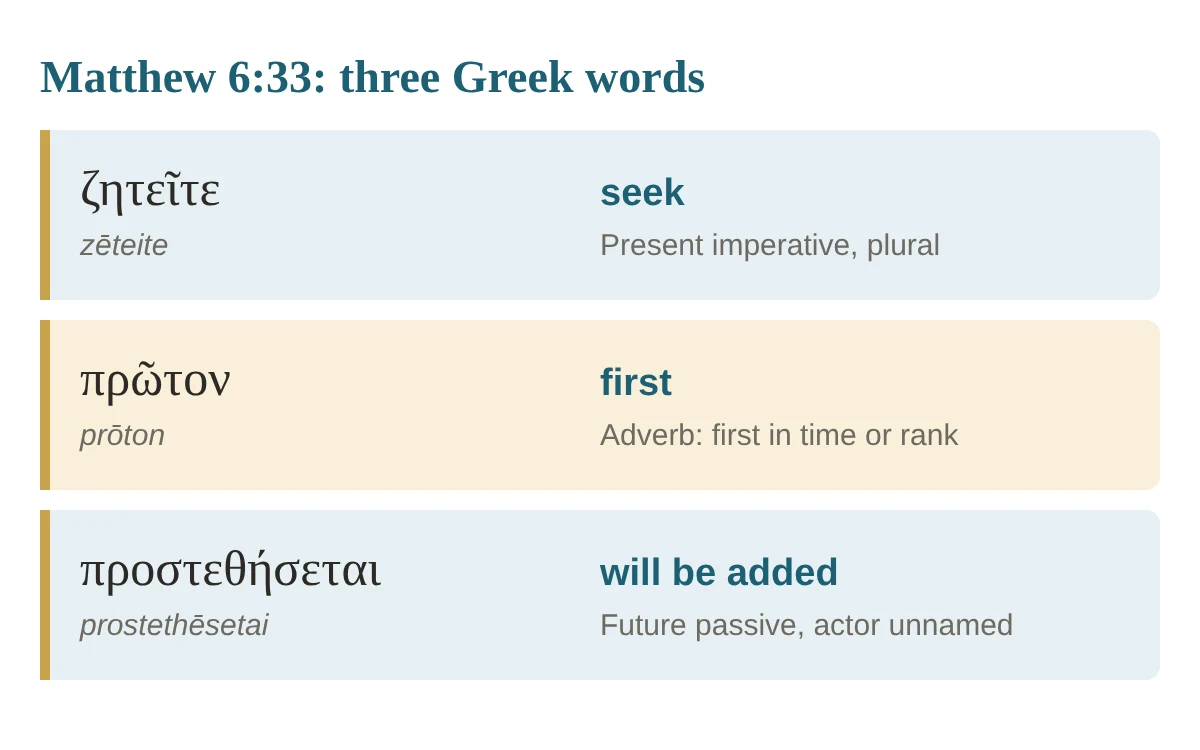
The verb for “seek” is zēteite, a present imperative, which carries the sense of continuing action: keep seeking. It is not a one-time decision at the start of a day or a life. Verse 32 uses a stronger relative of the same verb (epizētousin) for the Gentiles, who eagerly pursue food and clothing. Jesus sets two kinds of seeking side by side, and the disciple’s seeking has a different object.
“First” is prōton, which can mean first in time or first in rank. The context favours rank: this is about what governs the other pursuits, not a morning checklist. The worry that Jesus names in verse 25 is merimnaō, usually linked to a verb meaning “to divide.” Anxiety is a divided mind, and seeking first is the single-minded alternative, much as verse 22 speaks of a “healthy” or undivided eye.
“Will be added” is prosthethēsetai, a future passive. The passive hides the actor, and in Jewish speech that actor is God. The things are not earned by the seeking or produced by it. They are added alongside, the way a gift is added to what was already promised. Also, “you” is plural (hymin), so the promise is made to the community of disciples, not only to private individuals.
Try this: Write down the three things you worry about most this week. Next to each, write one thing you could do that serves God’s rule in that same area (for example, honest dealing at work, generosity, or forgiveness). Keep the list where the worries usually return.
“The kingdom of God” or “his kingdom”
Matthew normally writes “kingdom of heaven,” a phrase that avoids saying the divine name directly. “Kingdom of God” is a somewhat unusual phrase for Matthew’s Gospel, and in 6:33 the words “of God” are bracketed in the critical Greek text because some early manuscripts lack them. The KJV and BSB include them; many modern versions read simply “his kingdom,” pointing back to the Father in verse 32. The meaning is the same.
The underlying idea is God’s reign, His kingship in action, more than a territory. The Aramaic and Hebrew background (malkuta, malkut) is about rule. That fits the Lord’s Prayer, where “your kingdom come, your will be done” (Matthew 6:10) stands directly before the request for bread. The order of the prayer and the order of verse 33 are the same: kingdom first, bread after.
Christian traditions differ on how present or future the kingdom is. Some stress its arrival in Jesus’ ministry and its growth in the church; others stress its coming fulfilment at His return; many hold both, “already and not yet.” Verse 33 works under either view, since seeking is about allegiance now. A saying that bears on the nearness of the kingdom is at Luke 17:21.
What his righteousness means
Dikaiosynē is one of Matthew’s key words. It appears in the Beatitudes (“hunger and thirst for righteousness,” Matthew 5:6), in the warning that righteousness must exceed that of the scribes and Pharisees (5:20), and in 6:1, where it introduces teaching on giving, prayer and fasting. In these places it mostly describes a way of living that pleases God: faithful conduct from the heart.
Traditions emphasise different sides here. Many Protestant readers hear the echo of righteousness as God’s gift, the right standing He gives, and see conduct as its fruit. Catholic and Orthodox readers tend to stress righteousness as a life of grace-enabled obedience and love. Matthew’s own usage leans toward practice, yet nothing in the verse forbids both readings, and the words “his righteousness” can mean the righteousness God requires and the righteousness God gives.
Luke’s parallel (12:31) says only “seek his kingdom.” Matthew adds righteousness, which fits his steady concern that kingdom allegiance be visible in conduct. The pairing also protects the verse from a misreading: the kingdom is not a place to be reached while living however one likes.
What “all these things” covers
“All these things” (tauta panta) points back to verse 31: what to eat, what to drink, what to wear. It does not stretch to comfort, status or savings. Jesus is talking about the basic supplies of a day, the very things that the Gentiles chase and that the Father already knows His children need.
The verse also leaves room for how those needs are met. In Matthew 6:26 the birds are fed, yet they do not store grain; they are also not idle, because a bird’s day is spent finding food. The picture is of provision that comes through ordinary means, given by God, received without panic.
Verse 34 closes the thought: do not worry about tomorrow, since each day has its own trouble. Jesus does not deny that trouble exists. He limits the amount of it a person is asked to carry at one time.
How other translations render it
The English versions agree on the shape of the verse and differ on a few words:
- KJV: “seek ye first the kingdom of God, and his righteousness,” with things “added unto you,” using the older plural “ye.”
- BSB, ESV, NASB: “added,” which keeps the Greek verb literally.
- NIV and CSB: often render the promise as “given to you as well,” which is smoother English.
- NRSV: uses “strive” for the seeking, which catches the effort in the verb.
- NLT: paraphrases to seeking the kingdom “above all else,” and compresses the promise into God giving what is needed.
None of these is a mistranslation. “Added” preserves the sense of a bonus given with the main gift; “given” stresses the Giver. “Strive” and “above all else” bring out the force of prōton. A reader who compares two or three renderings gets a fuller picture than any one gives.
Common misreadings of Matthew 6:33
- A prosperity formula. The verse names food, drink and clothing, not wealth. Scripture also shows faithful people in need: Paul writes that he learned to be content when hungry (Philippians 4:12), and he writes in prison that God will supply every need (Philippians 4:19). The promise concerns God’s faithfulness, not guaranteed comfort. Augustine observed that when the apostle suffered hunger and thirst, God’s promises had not failed him.
- A reason not to work or plan. The Bible expects labor (2 Thessalonians 3:10) and praises foresight in the book of Proverbs. Jesus forbids anxious worry, not responsible effort.
- A bargain. “Seek first so that you get these things” turns the kingdom into a means to an end, which is exactly the self-serving seeking Jesus contrasts with the Gentiles. The promise is a result of the Father’s care, not a payment for devotion.
- A schedule. “First” is a matter of rank, not clock time. A person may spend most of the day on ordinary tasks and still be seeking the kingdom first in what governs those tasks.
- A rule for unbelievers only, or for no one today. The words were spoken to disciples about how they live, and the instruction has been read by Christians of every tradition as applying to them still.
How to apply Matthew 6:33 today
The most practical use is to treat the verse as a question asked before decisions: “What does faithfulness to God’s rule look like here?” Worry tends to ask what could go wrong; this verse asks what is right, and it puts that question ahead of the other one. Work, money, family time, and what to say yes to can all pass through it.
Several habits follow from the text itself:
- Pray the Lord’s Prayer slowly, noticing that the kingdom petitions come before the bread petition.
- Give before spending in some regular way, so that the first claim on income is not self-protection.
- Take the next faithful step on a problem, and set aside the rest of the worry until its day (verse 34).
- Seek alongside others, since the “you” is plural. Shared meals, shared giving and shared prayer put the verse into practice more than private effort does.
Try this: Tonight, say aloud one sentence in this form: “Father, I am worried about ___, and I hand it to you today. Show me one faithful thing to do about it.” Then do that one thing tomorrow.
The verse also works as a comfort for those who feel they are failing at it. It describes a direction, and the seeking is ongoing by design. Someone who returns to the kingdom a hundred times a day is doing what the present tense asks. A related promise to those who look for God with their whole heart is at Jeremiah 29:13.
Related verses
Luke 12:31 is the direct parallel and is worth reading with Luke 12:32, where the kingdom is called the Father’s good pleasure to give. Matthew 6:10 shows the same order in the Lord’s Prayer. In the Old Testament, 1 Kings 3:13 gives a close pattern: Solomon asks for wisdom to govern, and God adds riches and honor he did not request.
Deuteronomy 8:3 is the verse Jesus himself quotes when hungry in the wilderness, about living on every word from God’s mouth, and it shows the priority of verse 33 in His own life. Philippians 4:12 and 2 Thessalonians 3:10 keep the verse balanced: contentment when provision is thin, and honest work while trusting God to provide.
Cross references
Luke 12:31Luke's parallel, which leaves out righteousness and stresses the kingdom as gift.
But seek His kingdom, and these things will be added unto you.
Matthew 6:10The kingdom petition sits just before the request for daily bread.
Your kingdom come, Your will be done, on earth as it is in heaven.
1 Kings 3:13Solomon asked for wisdom and received the unrequested extras.
Moreover, I will give you what you did not request—both riches and honor—so that during all your days no man in any kingdom will be your equal.
Deuteronomy 8:3Jesus' own answer to hunger, quoted in the wilderness.
He humbled you, and in your hunger He gave you manna to eat, which neither you nor your fathers had known, so that you might understand that man does not live on bread alone, but on every word that comes from the mouth of the LORD.
Philippians 4:12Paul knew hunger, which keeps the promise from being a formula.
I know how to live humbly, and I know how to abound. I am accustomed to any and every situation—to being filled and being hungry, to having plenty and having need.
2 Thessalonians 3:10Trusting God for provision never cancelled ordinary work.
For even while we were with you, we gave you this command: “If anyone is unwilling to work, he shall not eat.”
Common questions
What does Matthew 6:33 mean in simple terms?
Jesus tells anxious disciples to make God's rule and God's way of living their steady first concern. He promises that the Father, who already knows their need for food and clothing, will supply those things as well.
Is Matthew 6:33 a promise of wealth?
No. The 'things' in the verse are the food, drink and clothing named in verse 31, which are daily necessities. The verse describes a Father who provides, not a method for getting rich, and Scripture records faithful people who went hungry.
What is the difference between the kingdom of God and his righteousness?
The kingdom is God's reign, His rule over people and the world. Righteousness is the kind of life that fits under that rule, in right standing and right conduct. Matthew pairs them because the King's rule shapes how His people actually live.
Does Matthew 6:33 mean Christians should not plan or work?
No. Jesus forbids anxious, divided worry, not planning or labor. Elsewhere the New Testament expects believers to work and provide for their households, and Proverbs praises forethought.
What is the parallel to Matthew 6:33 in Luke?
Luke 12:31 carries the same saying, but it speaks only of seeking his kingdom, without the word righteousness. Luke follows it with the assurance that the Father is pleased to give the kingdom to His little flock.
Why do some Bibles say 'his kingdom' and not 'the kingdom of God'?
The words 'of God' are bracketed in critical editions of the Greek text because some early manuscripts omit them. Either way, 'his' points back to the heavenly Father in verse 32.