
John 14:6: Meaning of "I Am the Way, the Truth and the Life"
Jesus answered, “I am the way and the truth and the life. No one comes to the Father except through Me.
Jesus saith unto him, I am the way, the truth, and the life: no man cometh unto the Father, but by me.
Choose a background, then download your image.
Download imageIn context
4You know the way to the place where I am going.”
5“Lord,” said Thomas, “we do not know where You are going, so how can we know the way?”
6Jesus answered, “I am the way and the truth and the life. No one comes to the Father except through Me.
7If you had known Me, you would know My Father as well. From now on you do know Him and have seen Him.”
8Philip said to Him, “Lord, show us the Father, and that will be enough for us.”
John 14:6 is Jesus’ reply to a worried disciple: he is himself the road to God, the full reality of who God is, and the source of life, and no one reaches the Father except through him. The sentence does not give directions. It points to a person.
The words were spoken on the night before the crucifixion, to friends who were afraid. Read in that setting, the verse works first as comfort and only afterward as a boundary.
What John 14:6 means
The Berean Standard Bible renders the verse: “I am the way and the truth and the life. No one comes to the Father except through Me.” The King James Version reads: “I am the way, the truth, and the life: no man cometh unto the Father, but by me.” The verse has two halves. The first makes three identity claims. The second states what follows from them.
Jesus does not say he shows the way, teaches the truth or hands out life. Each noun is something he is. That is why the verse could not be separated from him and turned into a method.
Thomas and the question behind the verse
The verse sits inside the Upper Room discourse (John 13 to 17). Jesus has just told the disciples, “Do not let your hearts be troubled” (John 14:1, BSB). He has said he is going to prepare a place in his Father’s house and that they know the way there.
Thomas objects. He does not know the destination, so how could he know the road? The question is practical and honest, and Jesus answers it by changing what a road is. The destination is the Father, and the route is Jesus himself.
Philip speaks next. His request, “show us the Father,” draws Jesus’ reply that seeing him is seeing the Father. The conversation continues in John 14:8. Thomas is remembered for doubt, yet in John 20:28 he is the one who says “My Lord and my God.” The man who asked for the way is later the clearest voice in the Gospel that the way is Jesus.
Try this: Read John 14:1 to 11 aloud in one sitting, noting every question the disciples ask. Seeing verse 6 as an answer to a frightened person changes its tone.
The way: more than a road
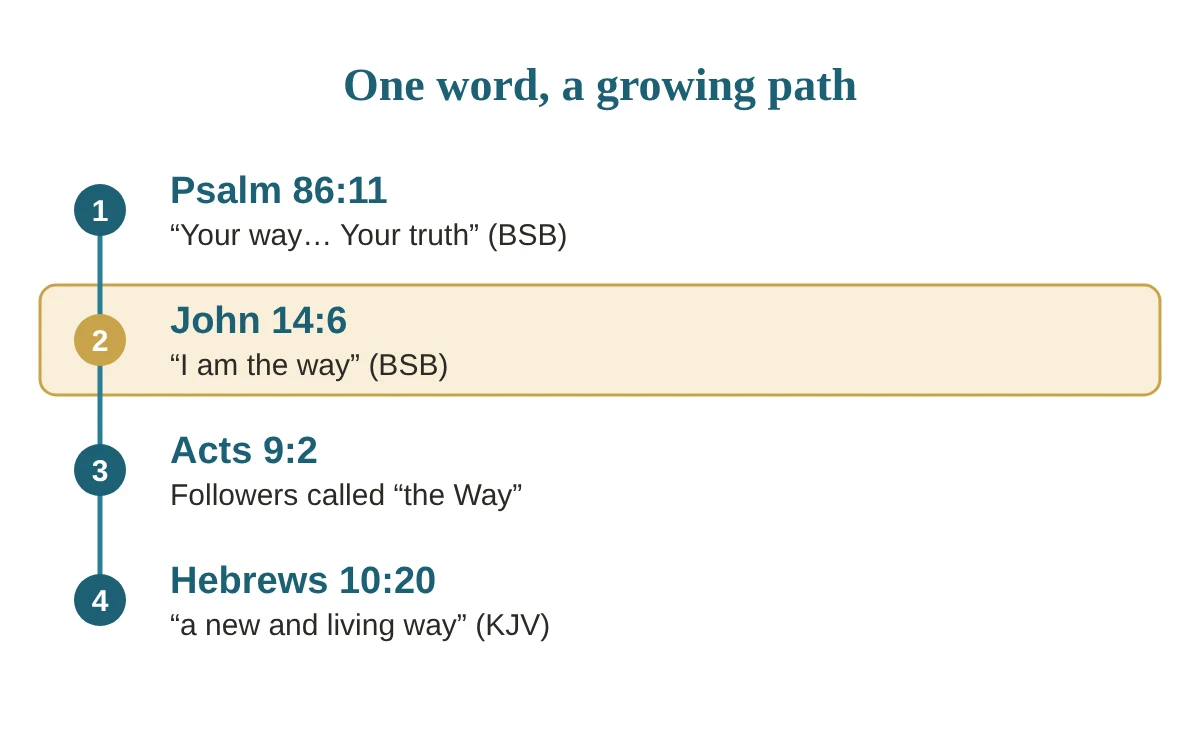
The Greek is hodos, the ordinary word for a road or path. For readers steeped in the Hebrew Scriptures, “the way” carried weight. Israel was told to walk in the way of the LORD, and one prayer asks, “Teach me Your way, O LORD; I will walk in Your truth” (Psalm 86:11, paraphrased). Way and truth were already neighbours in Israel’s prayers.
The early church took the word as its own name. Acts speaks of people belonging to “the Way” (Acts 9:2), which suggests believers understood their life as following a path set by Jesus. Hebrews speaks of “a new and living way” (Hebrews 10:20, KJV) opened through his body.
One detail is easy to miss. The road Jesus describes runs through the next few hours: Gethsemane, the trial and the cross. To follow the way is to follow someone who goes first through suffering, and who also said, “I am the door” (John 10:9). The Greek of “through me” (di’ emou) has the sense of passage, like entering a doorway.
The truth and the life
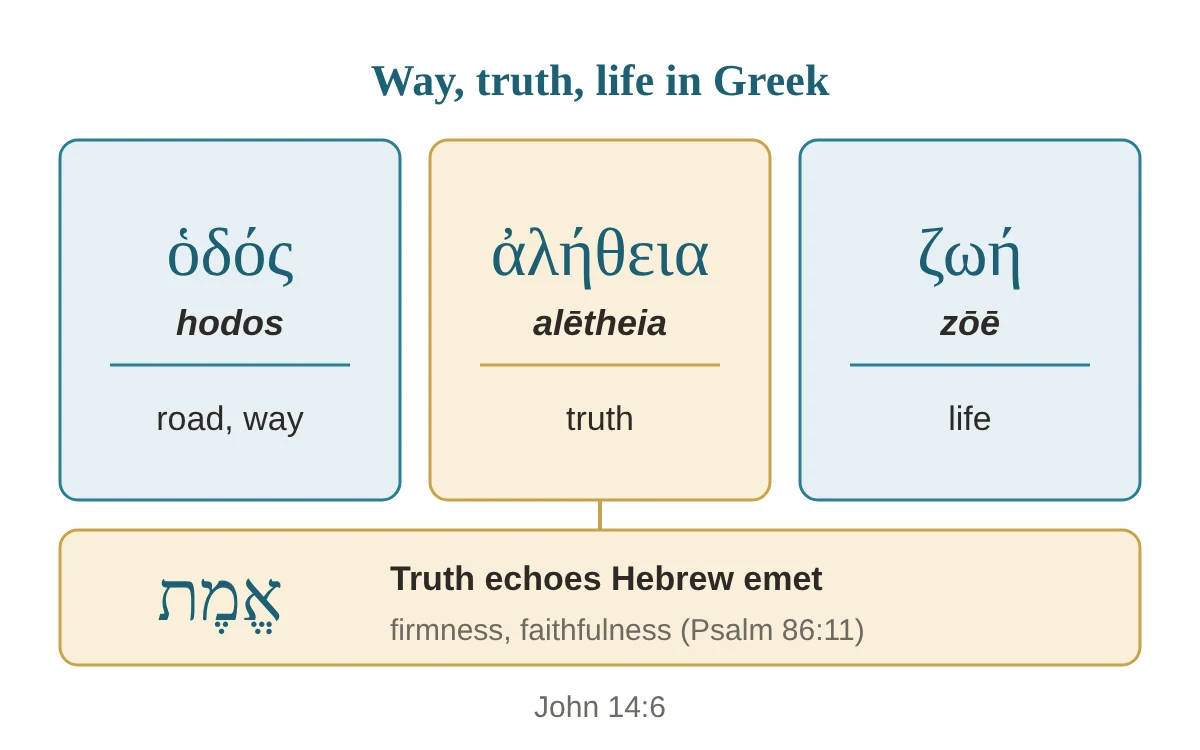
Alētheia, “truth,” is more than correct information. In Hebrew thought the matching word, emet, carries the sense of firmness and reliability: what holds when weight is put on it. In John, truth is something to be done and known, not only believed. Jesus’ words in John 8:32 about the truth setting people free belong with this verse, as does Pilate’s question in John 18:38, “What is truth?”, asked while the answer stood in front of him.
Zōē, “life,” is John’s favourite word for the life of God shared with people. It is distinct from bios, which means biological existence. Jesus had already said “I am the resurrection and the life” (John 11:25). John 17:3 explains the content: eternal life is knowing the only true God. See John 17:3 for the thought, which ties life to relationship and not just to length of days.
Grammar adds a nuance. Each noun has the article: the way, the truth, the life. Many scholars read the second and third nouns as explaining the first: the way is the way because Jesus is the truth about God and the life of God. Others read three coordinate claims. Either reading gives the same result, that the road and the destination are one person.
Try this: Write “way,” “truth” and “life” on three lines. Under each, note one place this week where you feel lost, misled or tired. Then read the verse over those three lines.
“No one comes to the Father”: the final clause
The Greek oudeis means “no one,” and the verb is in the present tense: no one is coming to the Father except through Jesus. The word “Father” is also deliberate. The goal is not a place or a verdict but a relationship, which matches the “Father’s house” of verse 2.
Jesus then says, “If you had known me, you would have known my Father also” (John 14:7, paraphrased from the KJV). This connects the claim to revelation. Because Jesus makes the Father known, he is the access, the same pattern John announced at the start: “the Word became flesh” (see John 1:14). The statement also echoes the “I am” tradition. The sixth of seven “I am” statements (with bread, light, door, shepherd, resurrection and vine), it stands near the claim of John 8:58, where Jesus uses the divine name for himself.
Elsewhere the New Testament states the same idea in different words. Paul writes of “one mediator between God and men” (1 Timothy 2:5, KJV). John 14:6 is the Gospel’s concentrated form of the claim.
How other translations render it
English translations are very close, so the differences are small but worth seeing:
- BSB, NIV, ESV: “No one comes to the Father except through me” (BSB capitalises “Me”).
- KJV: “no man cometh unto the Father, but by me,” where “man” means any person.
- NLT: adds the word “can” (“No one can come to the Father except through me”), which turns a statement of fact into one of possibility.
- Latin Vulgate: Ego sum via, et veritas, et vita, the phrase that became a familiar Latin motto.
The ESV and KJV place commas between the three nouns, while the BSB and NIV join them with “and.” The commas make three separate claims easier to hear, and “and” reads as one flow. The Greek links them with kai (“and”), so both are defensible.
Common misreadings of John 14:6
Several habits distort the verse, even among people who love it.
- Treating it as a weapon. The verse is a quotation to win an argument. In its setting it is a pastoral word to frightened friends, said with love.
- Reducing “the way” to a lifestyle. Jesus is not mainly describing a method of living. The claim is about who he is.
- Reading it as a statement about everyone’s eternal fate. The verse says how people come to the Father. It does not list who has or has not arrived, and it does not discuss those who never heard of Jesus.
- Hearing it as hostile to other people. The audience is eleven disciples, not a crowd of outsiders. It is a statement of identity before it is a debate position.
Another error runs the opposite way: softening “no one” until it means “many routes lead to God, and Jesus is a good one.” That requires ignoring the Greek definite articles and the plain sense of the final clause.
How Christian traditions read the exclusive claim
Almost all historic Christian traditions treat John 14:6 as making an exclusive claim about Christ. The differences are over its reach. Exclusivists hold that explicit faith in Christ is needed. Inclusivists hold that salvation comes only through Christ’s work, yet God may apply it to some who never heard the gospel. The Catholic Church, in Lumen Gentium 16 of Vatican II, takes this kind of position. Many Orthodox Christians confess Christ as the only way while leaving the fate of others to God’s mercy. Some Protestants also hold the same hope.
A third view, pluralism, says all religions lead to God. It denies the claim as stated, and it falls outside the historic creeds.
Where these traditions agree is the line the verse itself draws: Christ is the way, and no other name, effort or system replaces him. The question of how far his reach extends has been argued since the early church, and the verse does not settle it.
Living John 14:6 today
For someone who feels lost, the verse is an address, not a map. Direction comes from a person who has gone ahead and is coming back, as verse 3 promises. When life has no clear route, the first question is “Where is Christ in this?” and not “What is the plan?”
For someone anxious about death, the verse sits beside the words of peace in John 14:27. Jesus offers a peace the world does not give, and the road passes through death as well as past it.
In conversation with people of other faiths or none, the verse is best held with the humility it was spoken in. It is a confession about Jesus, offered as an answer to a real question, not a trump card. Telling someone “this is who I have found” lands better than reciting the verse as a rule.
Try this: Take one decision you are facing and write the question “What does it look like to follow Jesus here?” at the top of the page. Answer it in three sentences before asking what you want.
Related verses
Cross-references deepen the verse. Psalm 86:11 pairs way and truth in prayer. John 10:9 gives the door image. John 11:25 gives the life claim. Hebrews 10:20 describes the new and living way. Acts 9:2 shows believers called the Way. Psalm 16:11 speaks of “the path of life” and its joy in God’s presence, a Hebrew picture that Jesus’ words fulfil in a person. Read it alongside Psalm 16:11 to see how the old image and the new claim fit together.
Cross references
Psalm 86:11Way and truth already paired in Israel's prayer.
Teach me Your way, O LORD, that I may walk in Your truth. Give me an undivided heart, that I may fear Your name.
Acts 9:2Early believers were simply called the Way.
and requested letters to the synagogues in Damascus, so that if he found any men or women belonging to the Way, he could bring them as prisoners to Jerusalem.
Hebrews 10:20The way opened through Christ's body, a new and living road.
by the new and living way opened for us through the curtain of His body,
John 11:25Jesus claims to be the life before the cross.
Jesus said to her, “I am the resurrection and the life. Whoever believes in Me will live, even though he dies.
John 20:28Thomas, who asked the question, later gives the answer.
Thomas replied, “My Lord and my God!”
1 Timothy 2:5Paul's version: one mediator between God and people.
For there is one God, and there is one mediator between God and men, the man Christ Jesus,
Common questions
What does John 14:6 mean in simple terms?
Jesus says he is the road to the Father, the reality of who God is, and the source of real life. Access to God is not found in a system or a teaching that could be separated from him, but in a relationship with him.
Who was Jesus talking to in John 14:6?
Thomas, one of the twelve disciples, who had just said he did not know where Jesus was going or how to find the way. Philip speaks next, in verse 8, so the conversation involves more than one confused disciple.
Does John 14:6 say Jesus is the only way to heaven?
It says no one comes to the Father except through Jesus, and the destination named is the Father, not the word heaven. Christians agree the verse makes an exclusive claim about Christ, but they differ on how widely his saving work reaches.
Why does Jesus call himself the way, the truth and the life?
The way answers Thomas's question about direction. The truth and the life explain why the way works: Jesus reveals the Father and shares the life of God, so he is the destination as well as the road.
What is the Greek word for "way" in John 14:6?
It is hodos, meaning road or path. In Acts, the same word becomes a name for the early Christian movement, which was called the Way.
How is John 14:6 one of the "I am" sayings?
It is the sixth of seven "I am" statements in John's Gospel, each with a picture such as bread, light, door or vine. They echo the divine name given to Moses at the burning bush.