
Exodus 14:14: "The LORD Will Fight for You"
The LORD will fight for you; you need only to be still.”
The LORD shall fight for you, and ye shall hold your peace.
Choose a background, then download your image.
Download imageIn context
12Did we not say to you in Egypt, ‘Leave us alone so that we may serve the Egyptians’? For it would have been better for us to serve the Egyptians than to die in the wilderness.”
13But Moses told the people, “Do not be afraid. Stand firm and you will see the LORD’s salvation, which He will accomplish for you today; for the Egyptians you see today, you will never see again.
14The LORD will fight for you; you need only to be still.”
15Then the LORD said to Moses, “Why are you crying out to Me? Tell the Israelites to go forward.
16And as for you, lift up your staff and stretch out your hand over the sea and divide it, so that the Israelites can go through the sea on dry ground.
Exodus 14:14 is Moses’s word to Israel at the Red Sea: the LORD himself would fight the Egyptian army on their behalf, and Israel’s only part in that moment was to stop their terrified protest and be silent. It is a promise about who does the fighting, paired with a command about how to wait.
The verse is often read as “do nothing and God will handle it.” The Hebrew and the surrounding chapter point somewhere more interesting. Moses asks for silence, and within a few lines God asks for movement.
What Exodus 14:14 means
The verse has two halves. The first is a statement about God: he will fight, and he will do it for Israel. The second is a command to Israel: be silent. Between them they describe a reversal of normal expectations. A trapped people would be expected to fight, flee, or bargain. Moses tells them none of those is the plan.
The deeper claim is about who owns the victory. In the Exodus story, the defeat of Pharaoh is never credited to Israelite strength. Israel carries no sword in this chapter. The text insists on this so that the rescue can only be read as God’s act.
Who said it, to whom, and why
Moses speaks to the whole Israelite community, newly freed slaves who had left Egypt only days earlier. The verb “you shall be silent” is plural, so this is a word to a crowd, not a private comfort to one person.
The reason is visible in the verses just before it. The people were very afraid and cried out to the LORD, and then turned on Moses. In verses 11 and 12 Israel was blaming Moses and wailing that slavery was better. Moses answers the complaint directly. Verse 13 tells them not to fear, to stand firm and to watch what the LORD does that day, and verse 14 closes the sentence with the promise and the call to quiet.
The scene: trapped at the sea
Exodus 14:2 places the camp by the sea near Pi-hahiroth, between Migdol and Baal-zephon, and says God deliberately led them there. The location of the crossing is still debated, and so is the date of the exodus: an earlier date around 1446 BC and a later one in the thirteenth century BC both have scholarly defenders. The Hebrew name often rendered “Red Sea” is yam suph, which literally means “sea of reeds,” and scholars still discuss what body of water that names.
The geography matters because it removes every escape. Water ahead, chariots behind. Exodus 13:17 had already noted that God avoided the coastal road toward the Philistines because the people might panic at the sight of war and turn back. Israel is now facing exactly the kind of fear that verse anticipated, only worse.
“The LORD will fight for you”: the warrior God
The verb for fighting is lacham, the ordinary Hebrew word for waging war. Here it appears in a form that sounds almost like a wordplay with the next word: yillachem lakhem, “he will fight for you.” The preposition “for” can also be rendered “on your behalf,” which keeps the sense that God takes up the cause as his own.
The claim is confirmed from an unexpected mouth. In Exodus 14:25 the Egyptians themselves panic and say the LORD is fighting for Israel against them, using the same verb. Then Israel’s victory song in Exodus 15:3 names him a warrior. In the KJV it reads “The LORD is a man of war,” and the BSB renders the same line as “The LORD is a warrior.” Some Christian readers are uneasy with this language. The text presents it as God’s defense of the helpless against an oppressor, not as a general endorsement of violence.
The Hebrew behind “be still”
The command is one Hebrew word, tacharishun, from the root charash. The root’s basic sense is to be silent or hold your peace. Gesenius links the same verb form to being deaf, and the root has other uses unrelated to silence, including plowing and engraving, which is why context decides the meaning. Here the context is plain: Moses is answering the outcry of verses 10 to 12.
This is a different word from the one many people assume. Psalm 37:7 uses a verb from the damam family (“be still before the LORD”), and Psalm 46:10 uses raphah, which means to let go or loosen your grip. Popular piety has fused these “be still” verses into one idea, but they ask for different things. Exodus 14:14 asks Israel to stop talking in fear. Psalm 46:10 asks nations and individuals to drop their weapons and recognize who God is. A page on Psalm 46:10 takes up that second verse on its own terms.
Try this: Read Exodus 14:10 to 15 slowly and underline every verb Israel is told to do or not do. Notice how few there are, and where the silence ends.
How Exodus 14:14 is translated
Translations split between two ideas: stillness of body and silence of speech. The BSB reads “you need only to be still,” and the KJV reads “ye shall hold your peace.” The older Greek translation (the Septuagint) leans toward silence, and Brenton’s English version of it reads “ye shall hold your peace”.
- NIV: you need only to be still
- ESV and NASB: you have only to be silent / you shall be silent
- CSB: you must be quiet
- NLT: “The LORD himself will fight for you”, followed by an instruction to stay calm
- Douay-Rheims and NKJV: you shall hold your peace
“Still” captures the posture, “silent” captures the word. A careful reader benefits from holding both: the call is to a quiet that includes the mouth. Moses is not describing a calm temperament so much as the end of a particular kind of speech.
What happens in the very next verse
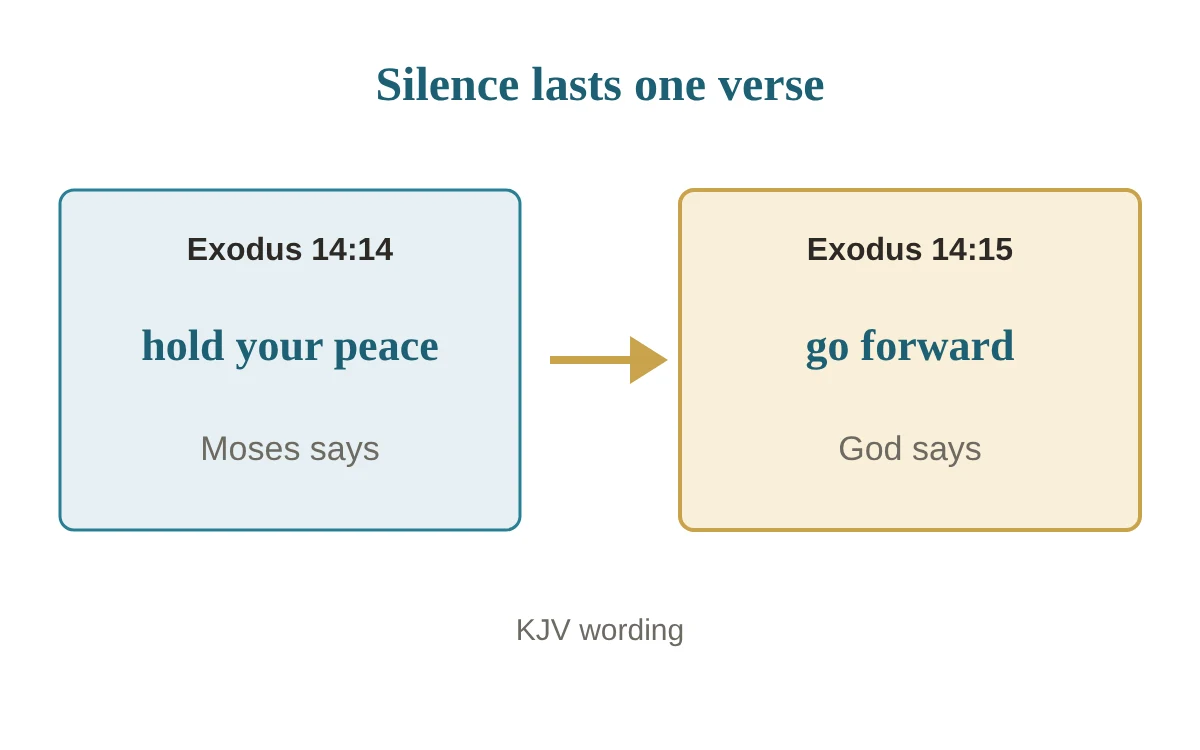
Verse 15 is the most overlooked part of the passage. God says to Moses, in the BSB, “Why are you crying out to Me?” and tells him to have the Israelites “go forward.” The KJV has “wherefore criest thou unto me? speak unto the children of Israel, that they go forward.” The silence lasts one verse. Then comes movement.
The following verses show the pattern holds: Moses is told to lift his staff and stretch out his hand over the sea, and Israel walks through on dry ground. God fights, and Israel still crosses. A traditional Jewish reading, preserved in the Mekhilta and quoted by Rashi, imagines the people split into four camps (surrender, suicide, battle, prayer) and has Moses answer each. Whether or not that exact scene happened, it captures how the verse works: it speaks to several panicked instincts at once.
Common misreadings of Exodus 14:14
The first is “let go and let God” as a rule for all situations. The text allows that reading for only one verse. The second is treating the verse as a guarantee of victory in any fight a person happens to be in. It was spoken to Israel about a specific rescue, and Christians differ on how far it carries. Some read it as a pattern of how God treats his people. Others stress that the promise is tied to its context.
A third misreading is the most serious: using the verse to tell someone in a harmful situation to stay put and say nothing. Nothing in Exodus supports that. Israel’s story here is an escape from oppression, and God commands them to leave a place of danger by walking forward, not to remain in it. Silence in this verse is the end of panicked complaint, not a gag on a person who needs help or who needs to report harm.
A fourth is thinking that silence rules out prayer. Israel’s cry in verse 10 is already a prayer, and God’s reply in verse 15 is a rebuke for the way they are crying, not a ban on speaking to him.
Related verses
Several passages echo the pattern of God fighting while his people trust. Deuteronomy 3:22 and 20:4 give the same promise before battle. In 2 Chronicles 20:17, King Jehoshaphat’s army is told to stand and see the LORD’s salvation, yet they still march out, with singers in front. In Nehemiah 4:20 the builders hold weapons while saying “our God will fight for us,” so the promise and human effort sit side by side.
Isaiah 30:15 ties quietness and trust to strength. Zephaniah 3:17 uses the same root as Exodus 14:14 in a surprising way: in many readings, God himself “quiets” or is silent in his love over his people, so the silence runs both directions. See Zephaniah 3:17 for that verse in context.
In the New Testament, Paul’s question in Romans 8:31 (“If God is for us, who can be against us?”) carries the same confidence. Ephesians 6:12 reframes the enemy as spiritual, which is why many Christians apply Exodus 14:14 to unseen struggles. Christian traditions differ here: some read the Red Sea as a picture of baptism and Christ’s victory over sin and death, others keep the focus on God’s care in present trouble.
How to apply Exodus 14:14 today
The verse does not remove responsibility. It sorts it. Some things belong to God, such as outcomes, other people’s hearts and the timing of rescue. Other things belong to the person praying, such as the next obedient step, honest words and wise action. Panic usually blurs the two.
A practical reading of the command is to stop the kind of speech that is only fear talking: rehearsing worst cases, blaming, rewriting the past. That is the silence Israel was asked for. It leaves room for prayer, for asking advice and for hard decisions. It also leaves room for readers who are anxious by temperament, since the verse gives a task (be quiet, watch, then go forward) rather than a demand to feel calm. More help for those moments is gathered in Bible verses for anxious.
Try this: Write down the situation that is pressing hardest. Split the page in two: “God’s part” and “my next step.” Pray over the first column, then do only what is in the second.
Patience belongs in this too. Israel’s rescue came the same day, but later stories show God’s help taking years. Psalm 37:7 frames waiting as a way of trusting, and the passage sets no timetable for when the fight ends.
Try this: Choose one complaint you repeat to yourself this week. For one day, say nothing about it to anyone and bring it to God instead. Notice what you do next.
Cross references
Exodus 14:15God's immediate follow-up: stop crying out and go forward
Then the LORD said to Moses, “Why are you crying out to Me? Tell the Israelites to go forward.
Exodus 15:3Israel's own song names the LORD as the warrior
The LORD is a warrior, the LORD is His name.
2 Chronicles 20:17Same promise renewed, but Judah still marched out
You need not fight this battle. Take up your positions, stand firm, and see the salvation of the LORD on your behalf, O Judah and Jerusalem. Do not be afraid or discouraged. Go out and face them tomorrow, for the LORD is with you.’”
Isaiah 30:15Quietness and trust named as the source of strength
For the Lord GOD, the Holy One of Israel, has said: “By repentance and rest you would be saved; your strength would lie in quiet confidence— but you were not willing.”
Nehemiah 4:20God fights for his people while they hold weapons
Wherever you hear the sound of the horn, rally to us there. Our God will fight for us!”
Psalm 46:10A different Hebrew verb: let go, relax your grip
“Be still and know that I am God; I will be exalted among the nations, I will be exalted over the earth.”
Common questions
What does Exodus 14:14 mean?
It means the battle at the Red Sea belonged to the LORD, not to Israel. Israel's task was to stop its panicked protest and trust while God dealt with Pharaoh's army.
Does "be still" in Exodus 14:14 mean do nothing?
No. The Hebrew verb means to be silent, and the very next verse has God telling Moses to move the people forward. The stillness covers fear and complaint, not obedience.
Who said Exodus 14:14 and to whom?
Moses spoke it to the Israelites camped by the sea, with Pharaoh's army closing in from behind. The "you" is plural, addressed to the whole community.
Is Exodus 14:14 the same as Psalm 46:10?
No. Exodus 14:14 uses a verb meaning to be silent, while Psalm 46:10 uses one meaning to let go or relax. Both call for trust, but they say different things.
Can Christians claim Exodus 14:14 as a promise today?
Most Christian traditions read it as a window into God's character and a pattern for trusting him, not a guarantee of a specific outcome. It was spoken to Israel about one particular rescue.
What is the Hebrew word for "be still" in Exodus 14:14?
It is tacharishun, from the root charash, meaning to be silent or hold one's peace. The same root can also mean to plow or to engrave, so context decides the sense.