
Joshua 1:9: Meaning, Context and Hebrew Behind "Be Strong and Courageous"
Have I not commanded you to be strong and courageous? Do not be afraid; do not be discouraged, for the LORD your God is with you wherever you go.”
Have not I commanded thee? Be strong and of a good courage; be not afraid, neither be thou dismayed: for the LORD thy God is with thee whithersoever thou goest.
Choose a background, then download your image.
Download imageIn context
7Above all, be strong and very courageous. Be careful to observe all the law that My servant Moses commanded you. Do not turn from it to the right or to the left, so that you may prosper wherever you go.
8This Book of the Law must not depart from your mouth; meditate on it day and night, so that you may be careful to do everything written in it. For then you will prosper and succeed in all you do.
9Have I not commanded you to be strong and courageous? Do not be afraid; do not be discouraged, for the LORD your God is with you wherever you go.”
10Then Joshua commanded the officers of the people:
11“Go through the camp and tell the people, ‘Prepare your provisions, for within three days you will cross the Jordan to go in and take possession of the land that the LORD your God is giving you to possess.’”
Joshua 1:9 is God’s personal commission to Joshua, spoken just after Moses’ death and just before Israel crosses the Jordan. It commands strong, resolute action, forbids paralysing fear, and rests the whole command on one promise: the LORD is with Joshua wherever he goes. The courage is not self-generated. It is a response to a presence already declared.
The verse is often printed alone on cards and mugs, which hides how much surrounds it. It is the third time in a few sentences that God gives the same order, and it is tightly bound to a command about Scripture. Reading it in that setting changes what it asks and what it promises.
What Joshua 1:9 Means
The verse has three moves. First, a reminder of authority: God has already issued the command. Second, two prohibitions: do not be afraid, do not be dismayed. Third, the ground for both: the LORD your God is with you in all that you do and everywhere you walk.
The order matters. The promise does not come first as a reward for being brave. The command stands, and the promise of presence is the reason it can be obeyed. In the Hebrew word order, “for the LORD your God is with you” is the hinge of the sentence, and everything before it depends on it.
Courage in this verse is therefore practical rather than emotional. It describes someone who keeps moving on the task God assigned while the threat is still visible.
Who God Was Speaking To, and Why
The speaker is the LORD (Yahweh) and the listener is Joshua son of Nun. Joshua began life as Hoshea and was renamed by Moses (Numbers 13:16). He had served as Moses’ attendant since the Exodus, fought Amalek, and was one of only two spies who urged Israel to enter the land forty years earlier. Moses had been told to commission him publicly (Numbers 27:18-23).
The setting is the plains of Moab, on the east side of the Jordan. Moses is dead, the old generation that refused to enter Canaan has died in the wilderness, and a river in flood stands between the people and the land (Joshua 3:15). Dating differs among scholars, depending on whether the Exodus is placed in the fifteenth or thirteenth century BC, but the narrative situation is clear: an untested leader succeeding the greatest figure in Israel’s memory.
God’s opening words in verse 5 settle the main anxiety: Joshua is being placed in Moses’ position, and the promise is explicit: “as I was with Moses, so I will be with thee” (KJV). The courage requested is the courage of a successor who does not need to become Moses, only to trust the same God.
Why Verse 9 Follows a Command About the Law
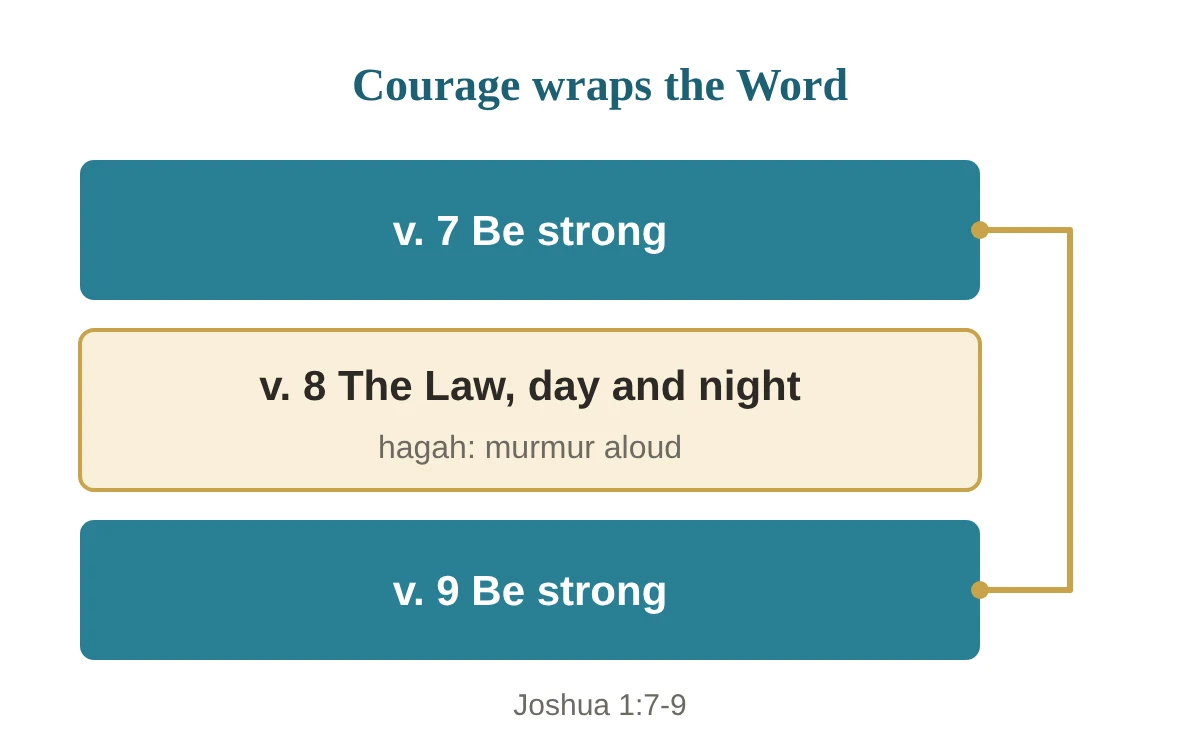
Verses 7 and 8 are easy to skip when quoting verse 9, and they change its meaning. God tells Joshua to be careful to do all the law of Moses, not to turn to the right or the left, and to “meditate on it day and night” (BSB). The Hebrew verb for meditate (hagah) suggests murmuring or speaking quietly aloud, so the book is meant to be rehearsed, not just owned.
Verse 9 then arrives as the summary: have I not commanded you? Strength and courage are tied to fidelity. A leader steady in the word has no need to take his bearings from enemy walls or the mood of the camp. This is also why the passage can be called a leadership text, and why rabbinic commentary stresses Joshua’s shift from Moses’ assistant to a confident leader in his own right.
Joshua 1 is the traditional prophetic reading for Simchat Torah in many Jewish communities, the day the annual Torah cycle ends and begins again. The choice is fitting: it joins the close of Moses’ scroll to the opening of the next book.
Try this: Read Joshua 1:6-9 aloud slowly, then read it again starting at verse 7. Notice that the courage command sits directly next to the command about the law, and write down one concrete way Scripture could steady the specific decision you are facing this week.
The Hebrew Behind the Verse
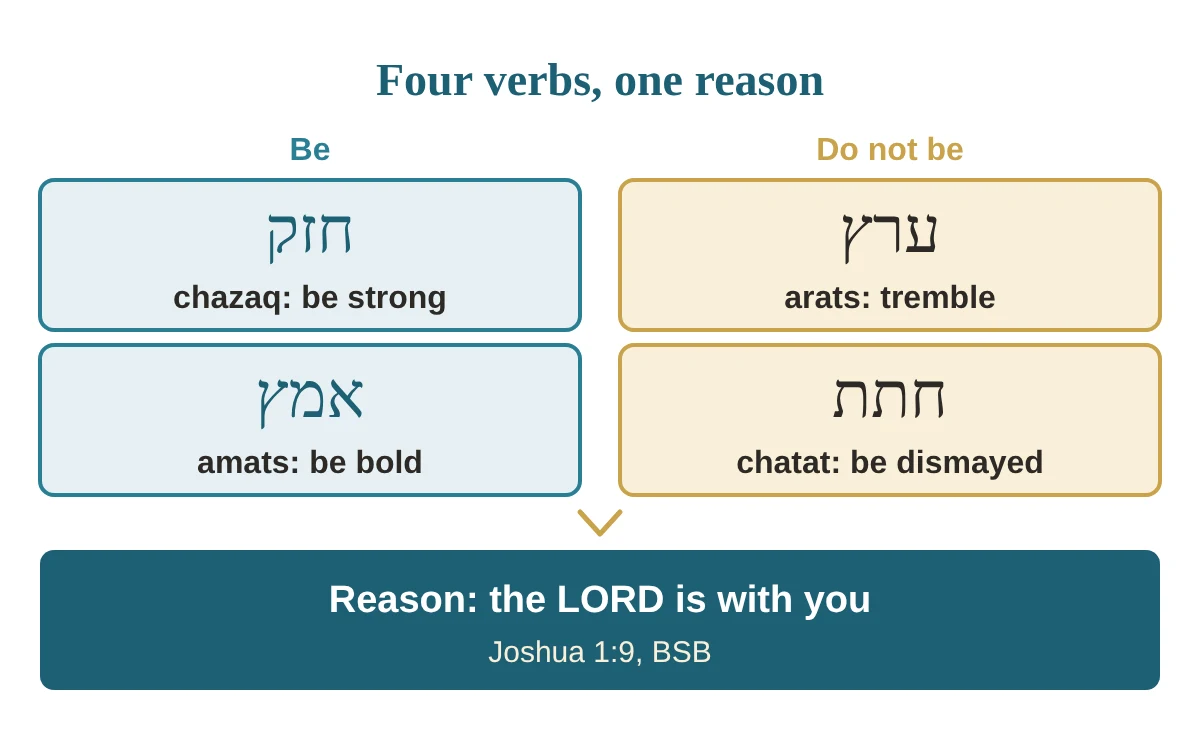
The first command is chazaq, “be strong.” The root means to be firm or to grip, and it is also used of Pharaoh’s hardened heart. The second is amats, to be bold or resolute. Together they form a paired formula that names settled resolve rather than a feeling. The KJV’s “of a good courage” is a faithful rendering of the second verb.
The prohibitions are more vivid. Arats (afraid) means to tremble or be terrorised, the reaction of a person in front of a stronger army. Chatat (dismayed) means to be shattered or broken, the kind of fear that collapses a person’s will. The pair covers both the shaking and the breaking.
The same two verbs appear together in Deuteronomy 1:29 and 31:8, where Moses recalls Israel’s failure to enter the land. The warning is deliberate: the fear that cost the previous generation forty years is not to be repeated. Finally, “wherever you go” translates a phrase meaning in all that you walk, which covers routes, decisions and ordinary movement, not just battles.
“Have I Not Commanded You?” A Question, Not a Pep Talk
Both the BSB and the KJV open verse 9 with a question. In Hebrew it is a rhetorical question expecting the answer “yes, you have.” It reminds Joshua of an authority already exercised. The word for command (tsavah) is the language of commissioning, used for an officer given a charge rather than for casual advice.
That shifts the tone. Joshua is not being coaxed into feeling better. He is being reminded that the matter is settled by the One who sent him. The question gently turns fear into a conflict between his feelings and a standing order.
This is also where the verse is often softened too far. “Do not be afraid” appears as a command, but the Hebrew prohibition is about conduct under fear, so it does not demand that a person never feel it. The rest of the book shows Joshua taking the army forward and still needing reassurance again (Joshua 8:1).
How Other Translations Render It
English versions agree on the shape of the verse but differ in small choices. The KJV keeps “dismayed,” a word that has narrowed in modern English, and “good courage.” The ESV and NKJV also keep “dismayed.” The BSB, NIV and NLT prefer “discouraged,” which is easier to understand but slightly weaker than the Hebrew idea of being broken.
Some versions begin with a statement, “I have commanded you,” rather than a question. Both readings are legitimate since the Hebrew particle can be translated either way, but the question form keeps the original rhetorical force.
The final clause is stable across translations: the LORD your God is with you. The only real variation is “in all that you do” versus “wherever you go,” and the Hebrew supports both. A reader comparing versions will find the verse remarkably consistent.
“Wherever You Go”: The Presence Promise and Its Echoes
The promise of presence is the oldest thread in the verse. God made essentially the same promise to Jacob at Bethel (Genesis 28:15), where it was also tied to going out and coming back to the land. Joshua 1:9 hands that patriarchal promise to the generation actually entering it.
Moses had spoken to the whole nation in the same terms (Deuteronomy 31:6), and then to Joshua personally. The pattern is a relay: the promise passes from patriarch to lawgiver to successor. Joshua later passes it on again, telling his officers to be strong and courageous before the southern campaign (Joshua 10:25), and the people repeat it to him in 1:18.
The presence of God is the reason the courage makes sense. The Hebrew reading in which God’s “with you” is a present, continuing state fits the narrative, since the Jordan crossing in chapter 3 is led by the ark, the sign of that presence.
Common Misreadings of Joshua 1:9
A few misreadings are common enough to deserve correction.
- Not a blank cheque. The verse is read as a promise that any venture will succeed if tackled boldly. The book itself disproves this: Israel loses at Ai in chapter 7 because of hidden sin, and is deceived by the Gibeonites in chapter 9 after failing to seek the LORD’s counsel.
- Not a ban on fear. Courage assumes fear exists. The commands would be meaningless otherwise.
- Not a motivational slogan. Cut from verses 7 and 8, it becomes self-confidence advice. In context, courage is bound to obedience and to the word.
- Not a transfer of Joshua’s mission. The conquest of Canaan was a particular assignment to a particular people. It is not a template for personal ambition or a mandate for violence.
The balanced reading keeps the presence promise broad and the commission narrow. That is what the rest of Scripture does, as the next section shows.
From Joshua to Every Believer
The New Testament writers apply the promise of presence to all believers while leaving the conquest behind. Hebrews 13:5 draws on the same Deuteronomy tradition: “I will never leave thee, nor forsake thee” (KJV), offered as a reason to be content. Matthew’s Gospel opens with Immanuel, “God with us” (Matthew 1:23), and closes with Jesus promising to be with his followers always.
Christian traditions differ in how far they carry the connection. Many Protestant readers apply the verse personally and devotionally, as long as the speaker and original audience are kept in view. Catholic and Orthodox traditions have long read Joshua as a figure of Christ as well: the Hebrew name Yehoshua is rendered Iesous in Greek, and the Fathers saw the leader who brings Israel across the Jordan into rest as foreshadowing Jesus. Both approaches treat verse 9 as pointing past Joshua to the God who is with his people.
Applying Joshua 1:9 Today
The verse works best when applied in the shape it was given. Begin with a clear assignment (what has God actually given you to do?), then locate the specific fear that threatens it. Then place the word of Scripture between the two, as verse 8 does.
Courage in the biblical sense often looks ordinary: telling the truth, staying faithful in a hard marriage or job, keeping a commitment when it costs. Paul uses the same kind of language for the church, “be courageous, be strong” (1 Corinthians 16:13), and his reminder that God gives a spirit of power, love and self-control (2 Timothy 1:7) matches the Hebrew sense of steady resolve.
The promise also works in situations that feel like dark valleys rather than battlefields. The same presence is the basis of Psalm 23:4, where the one who walks through the valley fears no evil because the shepherd is near.
Try this: Complete one sentence: “The LORD is with me as I…” Fill the blank with a real task or conversation you are avoiding, and say the sentence aloud before you begin it.
Related Verses
These passages sit closest to Joshua 1:9 in vocabulary or theme:
- Deuteronomy 31:6 and 31:8: Moses’ charge to Israel and to Joshua, with the same two verbs.
- Joshua 1:6-8: the earlier statements of the command, with the law of Moses as the source of courage.
- Joshua 10:25: Joshua passes the charge on to his officers.
- Genesis 28:15: the earlier promise of presence “wherever you go” to Jacob.
- Hebrews 13:5: the promise applied to every believer.
- Matthew 28:20: Jesus ends his commission with the promise of presence.
Read together, they show that the verse is part of a long conversation in Scripture about courage, command and the God who goes with his people.
Cross references
Deuteronomy 31:6Moses gives the same charge to all Israel first
Be strong and courageous; do not be afraid or terrified of them, for it is the LORD your God who goes with you; He will never leave you nor forsake you.”
Genesis 28:15Original 'wherever you go' promise, made to Jacob
Look, I am with you, and I will watch over you wherever you go, and I will bring you back to this land. For I will not leave you until I have done what I have promised you.”
Joshua 1:8The book of the law, the source of courage
This Book of the Law must not depart from your mouth; meditate on it day and night, so that you may be careful to do everything written in it. For then you will prosper and succeed in all you do.
Joshua 10:25Joshua hands the same words on to his officers
“Do not be afraid or discouraged,” Joshua said. “Be strong and courageous, for the LORD will do this to all the enemies you fight.”
Hebrews 13:5Applies the presence promise to every believer
Keep your lives free from the love of money and be content with what you have, for God has said: “Never will I leave you, never will I forsake you.”
Matthew 28:20Jesus ends his commission with the same promise
and teaching them to obey all that I have commanded you. And surely I am with you always, even to the end of the age.”
Common questions
What does Joshua 1:9 mean in simple terms?
God commissions Joshua to lead Israel into Canaan and grounds the command in a promise: the LORD will be with him in every place he goes. Courage here is a settled decision to act on God's word, not the absence of fear.
Is Joshua 1:9 a promise for every Christian?
The commission to conquer Canaan belonged to Joshua alone. The promise of God's presence is extended to all believers elsewhere, for example in Hebrews 13:5 and Matthew 28:20.
What is the difference between 'afraid' and 'discouraged' in Joshua 1:9?
The two Hebrew verbs describe fear that makes a person tremble and a collapse of resolve that makes a person break down. The KJV renders the second as 'dismayed'.
How many times does God say 'be strong and courageous' in Joshua 1?
The charge appears three times in God's speech (verses 6, 7 and 9). The people then echo it back to Joshua in verse 18.
Does Joshua 1:9 guarantee success?
No. Joshua 1:7-8 ties success to obedience to God's law, and the book itself records defeat at Ai after Israel's disobedience. The verse promises God's presence, not an easy outcome.
Is Joshua 1:9 the same as Deuteronomy 31:6?
They are closely related but not identical. Moses speaks Deuteronomy 31:6 to the whole nation before his death, and God speaks Joshua 1:9 directly to Joshua afterward.