
Bible Verses About Strength in Hard Times
The Bible does not present strength in hard times as something a person produces. Its most-loved verses, including Psalm 46:1, Isaiah 40:31, 2 Corinthians 12:9 and 1 Peter 5:10, describe strength as something given, found or exchanged, and nearly all were written by people who were exhausted, imprisoned, exiled or grieving.
That context changes how the verses read. Several are quoted far from their original setting, and a few are widely misunderstood. What follows looks at the key passages by their original words and circumstances, so that each one can carry its full weight when it is needed.
What the Bible means by strength
English uses one word where the biblical languages use several, and the differences matter. Three Hebrew words carry most of the weight in the verses on this page:
- ʿoz is strength as power or might, the kind God is said to give his people (Psalm 29:11, Psalm 28:7).
- maʿoz is a stronghold or fortress, strength as a place to run into. Nehemiah 8:10 uses this form.
- ḥazaq is to be firm, to grip, to take hold. It is the word behind “be strong” in Joshua 1:9.
Greek adds another. In Paul’s letters, the verb endynamoō means to be filled with power from outside oneself. It appears in Philippians 4:13 and Ephesians 6:10, and in both places the power belongs to Christ and flows to the believer.
So biblical strength is often less about gritting teeth and more about where a person stands: inside a fortress, held by a hand, supplied from a source. That pattern recurs through every passage below.
God is our refuge and strength, an ever-present help in times of trouble.
God is described as a help who can actually be found when trouble is closest.
He gives power to the faint and increases the strength of the weak. Even youths grow tired and weary, and young men stumble and fall. But those who wait upon the LORD will renew their strength; they will mount up with wings like eagles; they will run and not grow weary, they will walk and not faint.
Strength is promised to the weary as an exchange, given to those who wait on the Lord.
Do not fear, for I am with you; do not be afraid, for I am your God. I will strengthen you; I will surely help you; I will uphold you with My right hand of righteousness.
Strength is tied to God's presence and the upholding of his right hand.
I can do all things through Christ who gives me strength.
Paul's claim about contentment and endurance, written while he was in chains.
But He said to me, “My grace is sufficient for you, for My power is perfected in weakness.” Therefore I will boast all the more gladly in my weaknesses, so that the power of Christ may rest on me. That is why, for the sake of Christ, I delight in weaknesses, in insults, in hardships, in persecutions, in difficulties. For when I am weak, then I am strong.
God's answer to an unanswered prayer: grace is enough, and power shows up in weakness.
Then Nehemiah told them, “Go and eat what is rich, drink what is sweet, and send out portions to those who have nothing prepared, since today is holy to our Lord. Do not grieve, for the joy of the LORD is your strength.”
Spoken to a grieving people, it names joy in the Lord as a place of safety.
Though the fig tree does not bud and no fruit is on the vines, though the olive crop fails and the fields produce no food, though the sheep are cut off from the fold and no cattle are in the stalls, yet I will exult in the LORD; I will rejoice in the God of my salvation! GOD the Lord is my strength; He makes my feet like those of a deer; He makes me walk upon the heights! For the choirmaster. With stringed instruments.
A prophet chooses to rejoice even when every source of food has failed.
Have I not commanded you to be strong and courageous? Do not be afraid; do not be discouraged, for the LORD your God is with you wherever you go.”
A command to be strong, grounded in the promise that God goes with Joshua.
And after you have suffered for a little while, the God of all grace, who has called you to His eternal glory in Christ, will Himself restore you, secure you, strengthen you, and establish you.
Suffering is described as temporary, followed by God's own work of repair.
For the Lord GOD, the Holy One of Israel, has said: “By repentance and rest you would be saved; your strength would lie in quiet confidence— but you were not willing.”
Strength is found in returning, rest and quiet trust rather than frantic self-rescue.
My flesh and my heart may fail, but God is the strength of my heart and my portion forever.
When body and heart fail, God remains the strength and portion of the believer.
In the same way, the Spirit helps us in our weakness. For we do not know how we ought to pray, but the Spirit Himself intercedes for us with groans too deep for words.
The Spirit helps in weakness, even when words run out.
The LORD is near to the brokenhearted; He saves the contrite in spirit.
God is near to the brokenhearted, which is its own kind of strength.
I have told you these things so that in Me you may have peace. In the world you will have tribulation. But take courage; I have overcome the world!”
Jesus promises trouble and also promises that he has overcome.
But the Lord is faithful, and He will strengthen you and guard you from the evil one.
The Lord's faithfulness is the ground for being strengthened and guarded.
Therefore we do not lose heart. Though our outer self is wasting away, yet our inner self is being renewed day by day. For our light and momentary affliction is producing for us an eternal weight of glory that is far beyond comparison.
Outward wearing down and inward renewal happen at the same time.
The LORD is my strength and my shield; my heart trusts in Him, and I am helped. Therefore my heart rejoices, and I give thanks to Him with my song.
The Lord is both strength and shield, and trust leads to thanksgiving.
Psalm 46:1: a help that is found
The King James Version calls God “a very present help in trouble.” The Hebrew is more vivid: God is a help who is “found exceedingly” in distress. The verb suggests that when trouble arrives, God is already there to be discovered, rather than being summoned from far away.
Psalm 46 belongs to the Sons of Korah, temple singers, and is commonly linked to a moment when Jerusalem was threatened and spared. The imagery goes to extremes: mountains falling into the sea, waters roaring. The point is that even the most stable things on earth can give way and God does not. Martin Luther’s hymn “A Mighty Fortress” was inspired by this psalm.
The psalm also keeps one thing for the end. After the chaos, verse 10 turns to stillness. The command often printed on posters, “Be still,” is addressed to nations in the middle of a war, and it means to stop striving and acknowledge who God is. It is not a gentle suggestion to relax.
Isaiah 40:29-31: strength by exchange
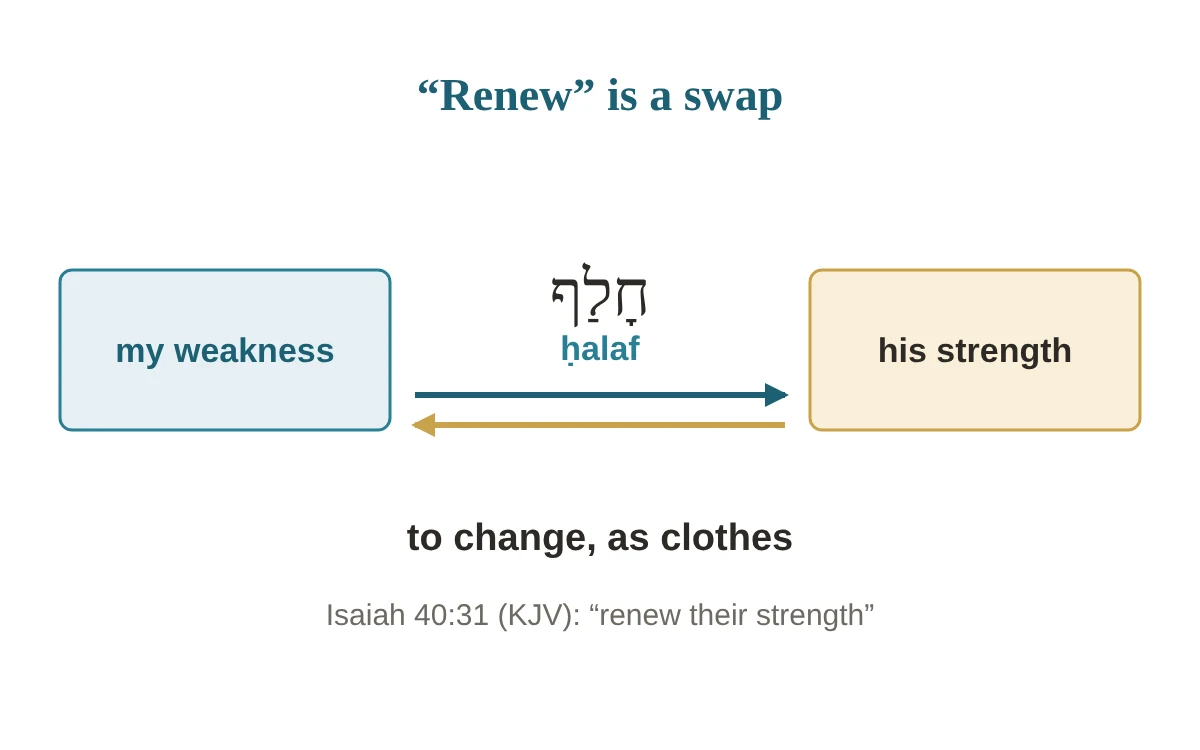
Isaiah 40 was addressed to exiles in Babylon who believed God had lost track of them. The promise in verse 31 that those who wait on the LORD “shall renew their strength” (KJV) hides two words worth knowing. “Renew” is ḥalaf, which means to change or swap, the word used when people change their clothes. The picture is not topping up a weak supply but trading weakness for God’s strength. See also the page on Isaiah 40:29 for the verse that opens this passage.
“Wait” is qavah, related to the word for a cord. It describes hope that is twisted and stretched like a rope, a tension held toward God rather than passive sitting around. The waiting is active expectation.
The order of the final line is also unexpected. Mounting up with wings and running are the dramatic outcomes, but the passage ends with walking and not fainting. For most people in a long hardship, the miracle is not flying. It is still being on their feet on day 400.
Philippians 4:13: strength from a prison cell
Few verses are quoted more often or more loosely. Paul wrote Philippians from prison, and the sentence before it explains the claim: he had learned to be content with little and with plenty, hungry or full. “All things” refers to that range of circumstances. The full study of Philippians 4:13 goes deeper into the grammar.
The Berean Standard Bible renders it “I can do all things through Christ who strengthens me.” The verb is the endynamoō mentioned above, a present participle, which implies ongoing supply and not one-time power. Paul is describing a daily dependence.
Read this way, the verse is not a promise of victory in a match or a business deal. It is something sturdier: a man who lost his freedom, reputation and comfort says that none of it has finished him. That is a promise a person in hospital, unemployment or bereavement can actually stand on.
2 Corinthians 12:9-10: power perfected in weakness
Paul asked three times for his “thorn in the flesh” to be removed. The Greek word, skolops, is closer to a stake or splinter than a plant thorn, and Paul never names it. The silence is useful: because the affliction is unspecified, believers facing very different sufferings have been able to see themselves in the passage.
The answer Paul received was not healing but a promise: “My grace is sufficient for you, for My power is perfected in weakness” (BSB). The word translated “sufficient” means enough, a measure and not an abundance. Grace here is not a feeling of relief. It is the adequate supply for the day. More on the surrounding chapter is at 2 Corinthians 12.
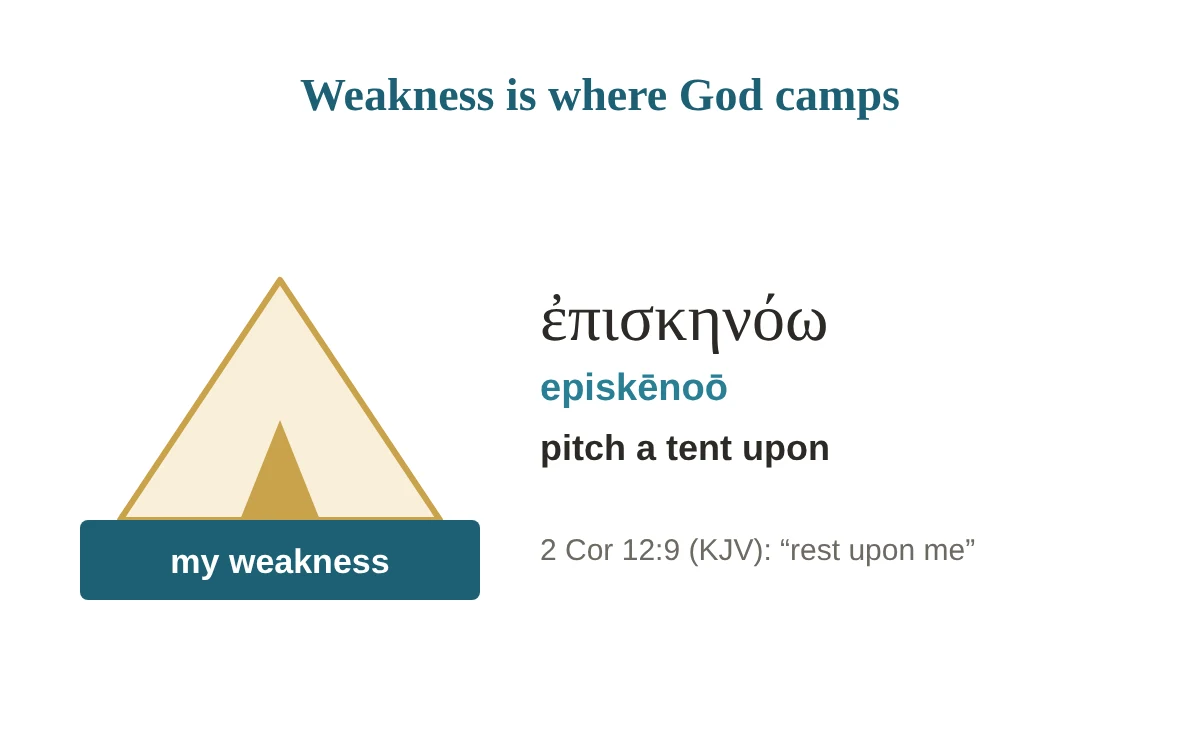
Paul continues that Christ’s power may “rest upon” him. The verb episkēnoō comes from the word for tent and echoes the way God’s glory dwelt over the tabernacle. Weakness, in other words, becomes the place where God pitches his tent. That is why “when I am weak, then I am strong” is not a riddle. Paul stops hiding his weakness because it is where God’s presence is felt most.
Try this: Name your own “thorn” in one honest sentence, then write beneath it what would count as “enough for today,” not enough for the whole year. Pray over only that.
Nehemiah 8:10: joy as a stronghold
The people of Jerusalem had just heard the Law read aloud for the first time in a long while, and they wept. Nehemiah and Ezra told them not to grieve, for “the joy of the LORD is your strength” (BSB). It was a festival day, the first of the seventh month, and a time for feasting and sending portions to those who had nothing.
Two Hebrew details deepen it. The word for joy, ḥedvah, is rare, found here and in 1 Chronicles 16:27, where it describes strength and joy in God’s own dwelling place. The word for strength is maʿoz, the stronghold. Joy is therefore something to take refuge in. It is not a mood that must be produced before a person is allowed to cope.
It is also ambiguous in a helpful way: the phrase can mean the joy God has in his people, or the joy people have in him. Both are consistent with the passage. The fuller verse-level treatment is on the page for Nehemiah 8:10.
Habakkuk 3:17-19: strength with empty fields
Habakkuk wrote as Babylon’s army approached. His closing prayer lists what could fail: no figs, no grapes, no olives, no flocks in the pen. After every item of the list comes the word “yet.” He chooses to rejoice in the LORD, and says God “is my strength” (KJV).
The next image is of feet like a deer’s. Mountain deer place their back feet where their front feet were, and are sure-footed on dangerous slopes. Habakkuk does not ask for a flat road. He asks for steady footing on steep ground.
The chapter ends with a note that it is for the choirmaster, on stringed instruments. The prophet’s response was meant to be sung. For many Christians, singing through a season has been a practical way to keep Habakkuk’s “yet” alive when argument and analysis run out.
Joshua 1:9: a command with a reason
“Be strong and courageous” is spoken to a man who has just lost his mentor. Moses is dead and Joshua must lead a people into a land full of fortified cities. The Hebrew pair is ḥazaq and ʾamats, firmness and boldness. Notably, the phrase occurs three times in the opening chapter, and in verse 7 the strength is explicitly tied to keeping the Law. It was not mainly about military bravery but about faithful obedience under pressure. The same words appear in Deuteronomy 31:6, spoken by Moses to the whole nation before his death.
The command is not left bare. It is followed by the reason: the LORD your God is with you wherever you go. Courage here is not a personality trait to be summoned. It is a response to presence. The study of Joshua 1:9 looks at this in detail.
The command can seem unfair to someone who feels afraid. But the verse presumes fear. Nobody is told to be courageous who is not frightened. Strength in this sense means acting faithfully while afraid.
1 Peter 5:10: four verbs of repair
Peter wrote to Christians in Asia Minor facing social hostility. After warning about an adversary prowling like a lion, he closes with a promise: after “a little while” of suffering, God himself will restore, make strong, firm and steadfast (BSB). In Greek these are four verbs, and each has a physical background.
Katartizō (“restore”) is the word used for mending fishing nets in Mark 1:19. Sthenoō (“strengthen”) appears only here in the New Testament. Themelioō (“make firm”) means to lay a foundation. The imagery is of repair, strengthening, and rebuilding from the ground up. A fuller look is at 1 Peter 5:10.
The grammar also matters: the subject is “the God of all grace,” and the verbs describe what he will do. Suffering is not praised, and it is given a time limit. The strength is not something the sufferer builds but something done to and for the sufferer after the pressure has done its work.
Isaiah 30:15: quiet strength, not passivity
Judah was in political danger and the leadership wanted to send to Egypt for horses and chariots. Isaiah delivered a different plan: “in quietness and in confidence shall be your strength” (KJV). Then he added the sad line: “you were unwilling.”
The passage is easy to misread as an instruction to do nothing. It is better understood as a refusal to panic. The alternative to Egypt was not inaction but trust in God, expressed through repentance (“returning”) and steadiness. The next verses show the people vowing to flee on horses instead.
For modern readers, the question the passage poses is where the first instinct goes in a crisis. Preparation and sensible steps are never condemned in Scripture. The issue is whether the frantic search for an escape is replacing trust, or flowing from it.
Psalm 73:26 and Romans 8:26: when the heart gives out
Asaph wrote Psalm 73 after nearly losing faith over the prosperity of the wicked. He arrives at a startling admission: “my flesh and my heart faileth,” yet “God is the strength of my heart” (KJV). The Hebrew for strength here is tsur, rock, so the phrase is literally “rock of my heart.” The next word, “portion,” recalls the Levites, who received no land and were told that God himself was their inheritance (Numbers 18:20). Asaph claims the same.
The New Testament gives a parallel for people who cannot even pray. Romans 8:26 says the Spirit “helps us in our weakness,” and intercedes with groanings too deep for words. The strength in view is not eloquence. Alongside it, Psalm 34:18 says the LORD is near to the brokenhearted, which has comforted many who had no strength left but their own presence in a room.
Both passages say something simple. When a person is out of resources, the Bible does not tell them to find more. It says someone else carries the weight.
Try this: When you cannot pray, say one sentence only: “Lord, I am weak. Be my rock.” Repeat it slowly for two minutes. Nothing more is required.
John 16:33: honest about trouble
Jesus said this on the night before his crucifixion, to disciples who were about to scatter. “In this world you will have trouble” is the honest half of the promise, and the other half is “I have overcome the world.” The Greek word for trouble, thlipsis, means pressure, being squeezed. It is the same word used for the pressure of crushing grapes.
The tense of “overcome” is the perfect, nenikēka: a victory already won with lasting results. Jesus is not telling them the fight will turn out well. He speaks from the other side of it. His words “take courage” use a verb he also uses with a paralyzed man and with frightened disciples on the lake. See John 16:33 for more.
Paul echoes the same realism in 2 Thessalonians 3:3, where the faithful Lord “will strengthen you and guard you from the evil one.” The emphasis is on guarding, not avoidance. In the biblical picture, strength coexists with trouble. It does not replace it.
“God will not give you more than you can handle”: a misreading
This sentence is often said to be in the Bible, and it is not. It is usually drawn from 1 Corinthians 10:13, but that verse is about temptation, in a context of Israel failing in the wilderness. It says God will provide a way out so that believers can endure the test. It does not say that suffering and grief will never exceed a person’s capacity.
Elsewhere, Paul says the opposite. In 2 Corinthians 1:8 he describes being under pressure far beyond his own strength, to the point of despairing of life. He then gives the purpose: it happened so he would rely not on himself but on God who raises the dead. The point of overload is dependence.
This matters for anyone told to cope because “God knows you can.” Scripture does not say that. It says that when strength is gone, God’s strength is available. The difference decides whether a hard season produces guilt or relief.
Strength is not suppression, and not solitary
The Bible’s strong people do not hide their pain. The Psalms include whole prayers of complaint. Jesus wept at Lazarus’s tomb and, in Gethsemane, prayed in anguish. In Luke 22:43 an angel strengthens him, a verse missing from some early manuscripts but retained in most traditions. Strength there does not look like calm detachment.
Elijah is another example. After a great victory he collapsed in despair and asked to die. God’s first response was not a lecture but food, water and sleep, twice (1 Kings 19:5-8). The recovery began with the body.
Strength is also shared. When Moses’ arms grew heavy in battle, Aaron and Hur held them up (Exodus 17:12). Ecclesiastes 4:9-12 says two are better than one, because one can lift the other who falls. Galatians 6:2 tells believers to carry one another’s burdens. Seeking help is not a failure of faith. It is one of the ways the Bible expects God’s strength to arrive.
Where traditions differ on suffering
Christian traditions agree that God strengthens his people but emphasize different things. Catholic and Orthodox Christians often link suffering with Christ’s own (Colossians 1:24) and look to the sacraments, such as the Eucharist and the Anointing of the Sick, as means of strength. Many Protestants stress God’s sovereignty and the promise of Scripture itself as the main source of strength, with Lutherans speaking of a “theology of the cross,” where God is found in weakness.
Pentecostal and charismatic Christians put particular weight on the Holy Spirit’s empowering presence and on expectant prayer for healing. Each tradition draws on the same passages. The difference is mostly in how, and through which means, strength is believed to be received.
None of these views makes Scripture’s promises smaller. A reader can hold any of them and still find the same texts sturdy: God present, God faithful, God strengthening those who are weak.
Using these verses when you are exhausted
A list of verses can become one more demand. Used well, a single verse is more like a handrail. Chosen to match the situation, it is easier to hold onto.
- Match the verse to the need. Exhaustion fits Isaiah 40, fear fits Joshua 1:9, grief fits Psalm 34:18, a refused prayer fits 2 Corinthians 12:9.
- Read the surrounding paragraph, not only the line. Context often supplies the comfort the single sentence lacks.
- Say it aloud in small pieces, one phrase per breath. Strength is easier to receive slowly.
- Tell one person which verse you are holding onto, so the strength is not carried alone.
Hope and strength are closely linked in Scripture, and the page on Romans 15:13 shows how Paul asks God to fill believers with hope by the Spirit’s power. Strength in the Bible is rarely a trait to admire. It is a gift to receive, repeatedly, in ordinary hours.
Try this: Pick one verse from this page and write it on a card. Put it where you will see it at the hardest time of day, and read it aloud once each time you pass.
Common questions
What is the best Bible verse for strength in hard times?
Psalm 46:1 and Isaiah 40:31 are the most often turned to, but the best verse depends on the hardship. Isaiah 40 suits exhaustion, 2 Corinthians 12:9 suits a prayer that was not answered as hoped, and Psalm 34:18 suits grief.
Does Philippians 4:13 mean I can do anything I want?
No. In context, Paul is describing contentment in both hunger and plenty while he sits in prison. The verse is about enduring any circumstance, not achieving any goal.
Is it true that God will not give me more than I can handle?
That sentence is not in the Bible. 1 Corinthians 10:13 is about temptation, and in 2 Corinthians 1:8 Paul says he was pressed beyond his own strength so that he would rely on God.
Is it a lack of faith to feel weak or cry when things are hard?
No. The Psalms are full of lament, Jesus wept, and he prayed in anguish in Gethsemane. Scripture treats honest weakness as the place where God's strength is received.
What does 'the joy of the Lord is your strength' mean?
The Hebrew word for strength can mean a stronghold or place of refuge. Nehemiah told a weeping people that joy found in God is something they can shelter in, not a mood they must produce.
How should I pray when I have no strength left?
Short, honest prayers are enough. Romans 8:26 says the Spirit helps believers in their weakness and intercedes when they do not know what to say.