
Bible Verses About Hope and What They Mean
In the Bible, hope is a confident expectation that God will do what he has promised, held while the promise is still unfulfilled. It is closer to a settled looking-forward than to the English wish of “I hope it works out.” The strongest verses on the subject, such as Romans 15:13, Lamentations 3:21-24 and Hebrews 6:19, were written in exile, prison or grief, not in comfortable times.
The verses above are shown in full. What follows looks at what the original words carry, where each verse was spoken, and where popular readings drift from the text. Quotations are from the Berean Standard Bible (BSB) unless marked KJV.
What hope means in the Bible
English uses “hope” for something uncertain. Biblical writers use it for something awaited with assurance, because the object of hope is God and his word. The result is a word with two sides: it is certain in its object and patient in its timing. Paul puts it directly in Romans 8:24-25: what is already seen is no longer hoped for, so hope belongs to what is still ahead.
That gives biblical hope three working features:
- It has an object. Psalm 146:5 blesses the one whose hope is in the LORD, and Psalm 33:17 calls the war horse a false hope for victory.
- It has a timeline. It waits, and the waiting is part of its nature.
- It has a cost. Almost every major hope text is set among loss, delay or danger.
The Bible also describes hope that fails. Ephesians 2:12 describes people as having “no hope and without God in the world,” and Job 8:13 says the hope of the godless perishes. The question in Scripture is rarely whether someone is hopeful. It is what the hope rests on.
For I know the plans I have for you, declares the LORD, plans to prosper you and not to harm you, to give you a future and a hope.
A promise written to exiles in Babylon, offering a future and a hope to a whole community.
Now may the God of hope fill you with all joy and peace as you believe in Him, so that you may overflow with hope by the power of the Holy Spirit.
Paul's closing blessing names God as the source of hope and the Holy Spirit as the power behind it.
Not only that, but we also rejoice in our sufferings, because we know that suffering produces perseverance; perseverance, character; and character, hope. And hope does not disappoint us, because God has poured out His love into our hearts through the Holy Spirit, whom He has given us.
Suffering, perseverance and proven character lead to a hope that does not disappoint.
For in this hope we were saved; but hope that is seen is no hope at all. Who hopes for what he can already see? But if we hope for what we do not yet see, we wait for it patiently.
Hope belongs to what is not yet seen, and it is carried with patient endurance.
Yet I call this to mind, and therefore I have hope: Because of the loving devotion of the LORD we are not consumed, for His mercies never fail. They are new every morning; great is Your faithfulness! “The LORD is my portion,” says my soul, “therefore I will hope in Him.”
Hope rises in the middle of national ruin by recalling the steadfast love of the LORD.
Why are you downcast, O my soul? Why the unease within me? Put your hope in God, for I will yet praise Him for the salvation of His presence.
A believer speaks to his own downcast soul and tells it to hope in God.
I wait for the LORD; my soul does wait, and in His word I put my hope. My soul waits for the Lord more than watchmen wait for the morning— more than watchmen wait for the morning.
Hope is pictured as watchmen waiting through the night for morning.
But those who wait upon the LORD will renew their strength; they will mount up with wings like eagles; they will run and not grow weary, they will walk and not faint.
Those who hope in the LORD exchange their weakness for new strength.
We have this hope as an anchor for the soul, firm and secure. It enters the inner sanctuary behind the curtain,
Hope is an anchor for the soul, fixed in the presence of God behind the curtain.
Blessed be the God and Father of our Lord Jesus Christ! By His great mercy He has given us new birth into a living hope through the resurrection of Jesus Christ from the dead,
The resurrection of Jesus gives believers a living hope and a new birth.
But in your hearts sanctify Christ as Lord. Always be prepared to give a defense to everyone who asks you the reason for the hope that is in you. But respond with gentleness and respect,
Christians are told to be ready to explain the hope that people can see in them.
Hope deferred makes the heart sick, but desire fulfilled is a tree of life.
Scripture admits honestly that delayed hope makes the heart sick.
Now faith is the assurance of what we hope for and the certainty of what we do not see.
Faith is described as the assurance of things hoped for.
Brothers, we do not want you to be uninformed about those who sleep in death, so that you will not grieve like the rest, who are without hope.
Christians grieve their dead, but not as people who have no hope.
as we await the blessed hope and glorious appearance of our great God and Savior Jesus Christ.
The blessed hope is the appearing of the glory of Jesus Christ.
To them God has chosen to make known among the Gentiles the glorious riches of this mystery, which is Christ in you, the hope of glory.
Christ in the believer is the hope of glory, a mystery now made known.
There I will give back her vineyards and make the Valley of Achor into a gateway of hope. There she will respond as she did in the days of her youth, as in the day she came up out of Egypt.
The Valley of Achor, a place of trouble, becomes a door of hope.
Though He slay me, I will hope in Him. I will still defend my ways to His face.
Job's words show hope surviving even when answers are withheld.
The Hebrew words behind hope
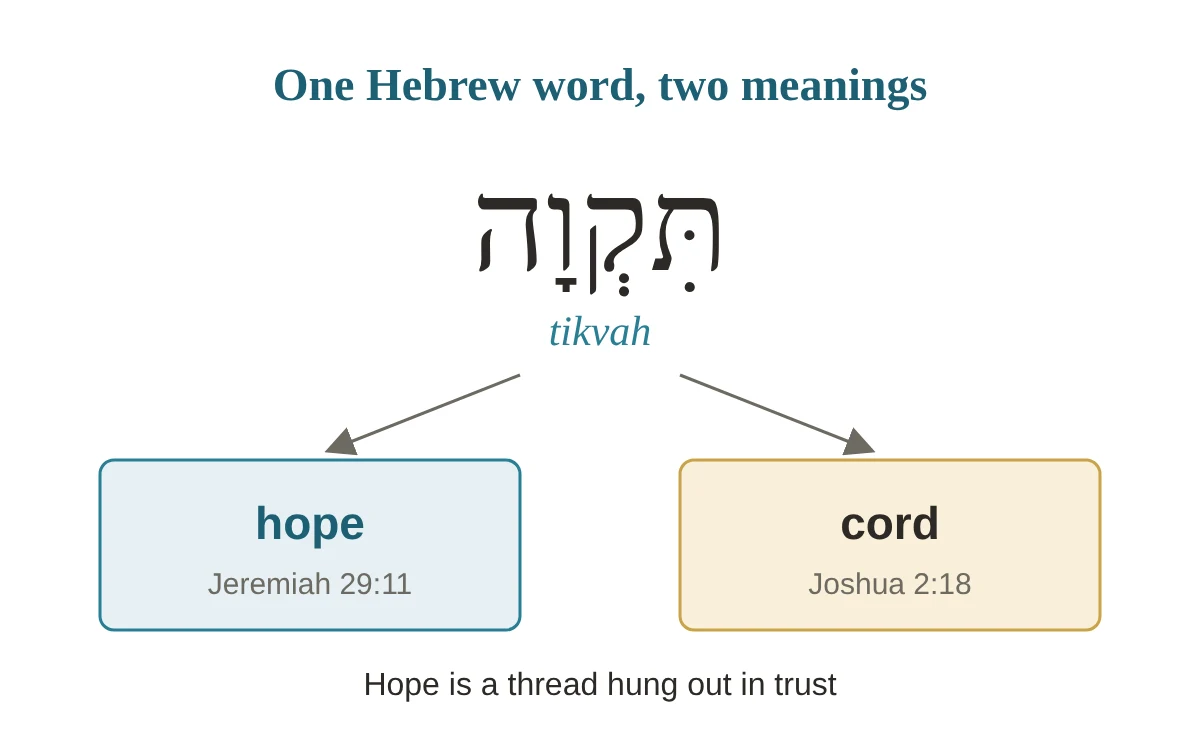
Two main Hebrew word families sit behind most Old Testament “hope” verses. The noun tikvah comes from the verb qavah, which means to wait or look eagerly. Many scholars connect it to the image of a stretched or twisted cord, hope as something pulled taut toward a future. The same noun is used in Joshua 2:18 and 2:21 for the scarlet cord Rahab tied in her window. Hope in that scene was a thread hung out in trust that a promise would be kept. The modern Israeli national anthem, Hatikvah, takes its name from the same word.
The second family is yachal, to wait expectantly. It is the verb in Psalm 42:5, Psalm 130:7 and Lamentations 3:24. It often travels with waiting, which is why older translations such as the KJV frequently say “wait” where modern ones say “hope.” In Isaiah 40:31 the KJV says “wait upon the LORD” and the BSB says “hope in the LORD.” Both are fair renderings, because in Hebrew thought the two actions are one.
Hosea 2:15 shows how far tikvah can reach. God promises to make the Valley of Achor a “door of hope.” Achor means trouble, and it was the place where Achan was judged after the defeat at Ai (Joshua 7). The prophet takes the most shameful site in Israel’s early history and says it will become an entrance.
Try this: Pick one hope verse from the list above and look up each word for hope in an interlinear or concordance. Write down whether the underlying word is about waiting, trusting, or taking refuge. The shade of meaning often changes how the verse reads.
Elpis in the New Testament
The Greek noun elpis and its verb elpizo cover the New Testament vocabulary of hope. Classical Greek could use elpis for neutral anticipation, even for fear of what was coming. New Testament writers narrow it to the confident expectation of good that God has promised. Paul pairs it constantly with hypomone, endurance or patient staying-under, as in Romans 8:25. Hope looks ahead while endurance holds ground.
Romans 8:18-25 is the fullest treatment. Paul describes creation groaning like a woman in labor and believers groaning with it while awaiting the redemption of their bodies. Hope here is not a coping device but a theology of a world not yet finished. The surrounding verses in Romans 8:18 set present suffering beside coming glory without denying how heavy the first is.
Romans 15:13 is Paul’s closing blessing in that letter, and it calls God “the God of hope,” a title found nowhere else in Scripture. Verse 12 has just quoted Isaiah 11:10, “In Him the Gentiles will hope,” so the blessing is about Jews and Gentiles together hoping in the same Messiah. The Holy Spirit supplies the overflow, which means hope is received as much as it is built. The full verse is covered on its own page at Romans 15:13.
Jeremiah 29:11 in its original setting
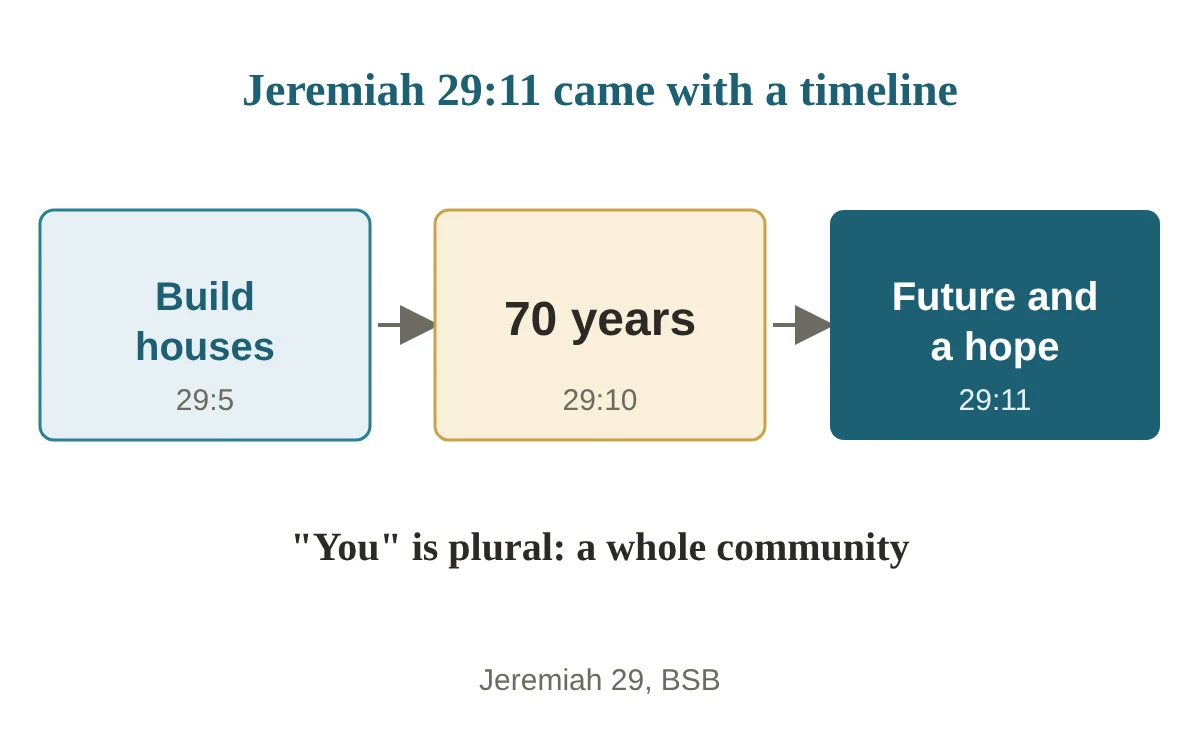
Jeremiah 29:11 is probably the most quoted hope verse and one of the most often lifted out of context. It sits in a letter from Jeremiah to Judeans already deported to Babylon. The verse before it (29:10) gives the timeline: seventy years. Most of the people who first read the letter would die in Babylon. The “you” in the verse is plural, addressed to the community and its descendants, not to a single person planning a career.
The instructions around the verse are also unglamorous. The exiles are told to build houses, plant gardens, marry, and seek the welfare of the city where they live (29:5-7). The “future and a hope” is real, but it arrives after a long stretch of ordinary faithfulness in a foreign land. The KJV’s “expected end” reflects the Hebrew acharit, a latter end, paired with tikvah.
There is a contrast in the previous chapter. Jeremiah 28 records the prophet Hananiah promising the exile would be over in two years. That was easy, popular hope, and it was false. Jeremiah’s hope was harder because it began with seventy years. Christians have long read the verse as showing God’s character more than as a guarantee of personal outcomes, a point developed further at Jeremiah 29:11.
Hope that grows out of suffering
Romans 5:2-5 is often summarized as “suffering produces hope,” but the sequence is more careful. Paul says believers already “rejoice in the hope of the glory of God” (verse 2) before suffering enters the picture. Suffering then deepens a hope that exists. The chain runs:
- Suffering produces perseverance.
- Perseverance produces character (the Greek dokime means proven, tested and found genuine).
- Character produces hope.
A common misreading takes this to mean suffering is good in itself. Paul does not say that. He says believers rejoice “knowing” what suffering produces. The line that carries the weight is verse 5, which says hope does not disappoint because God’s love has been poured out through the Holy Spirit. Hope holds because its ground is love already given, not because the person endured well.
This also explains why Hosea’s valley of trouble can become a door. The pattern in Scripture is that hope is not found by avoiding the hard place but by finding God in it. For readers looking at the same theme through the lens of endurance, the page on Bible verses about strength in hard times pairs well with this one.
Lamentations 3: hope in the ruins
Lamentations was written after Jerusalem fell to Babylon in 586 BC. The book is a set of five poems, and chapter 3 is an acrostic in which each letter of the Hebrew alphabet begins three consecutive verses. The poet starts with an unsparing account of affliction, and then at verses 21 to 24 says that one thing he calls to mind gives him hope. The structure is deliberate: the hope sits at the center of the book, surrounded by grief on both sides.
What he recalls is not an improvement in circumstances. The city is still in ruins. He recalls the hesed, the covenant love, of the LORD, which has not run out, and compassions that are renewed each morning. The famous lines about new mercies every morning are examined verse by verse at Lamentations 3:22-23.
The chapter does not resolve neatly. The lament resumes after the hope passage, and the book ends in chapter 5 with a question about whether God has rejected his people entirely. The poem does not treat hope and grief as opposites. Lamentations is still read aloud in Jewish synagogues on Tisha B’Av, the day of mourning for the destroyed temples, which shows how long the community has kept the two together.
Waiting verses: Isaiah 40:31, Psalm 42 and Psalm 130
Isaiah 40 speaks to exiles who feel overlooked. In verse 27 they complain that their way is hidden from the LORD. The promise in verse 31 uses the Hebrew verb chalaph, which means to exchange or change. Those who hope in the LORD swap their strength for his, which is a different image from simply getting stronger. The eagle, the runner and the walker are listed in ascending order of ordinariness, and the last, walking without fainting, is the hardest to sustain.
Psalm 42:5 records a believer talking to himself: why are you downcast, O my soul, hope in God. The refrain appears three times (42:5, 42:11 and 43:5). Repetition suggests that hope here is a discipline of address, something said again and again to a discouraged heart. The speaker does not feel hopeful. He instructs himself to hope.
Psalm 130:5-6 compares waiting to watchmen waiting for morning, and says it twice for emphasis. A night watchman knows the sun will rise; the only uncertainty is how long the dark lasts. That is a precise picture of biblical hope: certainty about the outcome, patience about the hour. Verse 7 then widens the invitation, telling all Israel to hope in the LORD.
Try this: Write out Psalm 42:5 and speak it aloud to yourself three times today, once in the morning, once at midday and once at night. Notice that the psalm repeats itself too.
Proverbs on delayed hope
Proverbs 13:12 is the Bible’s most honest line about waiting. The verb in “hope deferred” means drawn out or prolonged, and the result is a sick heart. The KJV renders the second half as “when the desire cometh, it is a tree of life.” Scripture does not pretend that a long delay is painless, and it does not treat that pain as a failure of faith.
The tree of life phrase is deliberate. It echoes the garden in Genesis and anticipates the tree in Revelation 22. A fulfilled desire is described in terms of restored life, not merely satisfaction. The proverb quietly sets everyday longing, such as for a child, healing or reconciliation, inside the larger story of what God is restoring.
Other proverbs add a long view. Proverbs 23:18 and 24:14 say there is a future (again acharit) and that the hope will not be cut off. Proverbs 10:28 says the hope of the righteous brings joy, while the expectation of the wicked comes to nothing. Together they teach that hope is judged by where it ends up, not by how comfortable the wait is.
The anchor in Hebrews 6
Hebrews 6:19 calls hope “an anchor for the soul, firm and secure” (BSB). The context is the oath God swore to Abraham (6:13-18). The writer argues that two unchangeable things, God’s promise and God’s oath, give believers strong encouragement, because it is impossible for God to lie. The anchor is only as good as the promise it is hooked to.
The next phrase surprises readers who picture an anchor going down into the sea. This anchor enters “behind the veil,” the inner sanctuary of the temple, where Jesus has gone ahead as a forerunner (6:20). The anchor is set in heaven, not on the seabed. The believer is held from above, which is why storms below do not dislodge it.
Early Christians quickly took to the image. Anchors appear in the art of the Roman catacombs, sometimes as a recognizable disguise for the cross. The longer treatment of the verse is at Hebrews 6:19.
A living hope in 1 Peter
First Peter was written to scattered Christians in what is now Turkey, a minority facing social hostility. Peter opens by blessing God for giving “a living hope” through the resurrection of Jesus (1:3). The adjective matters. A living hope is one that cannot die because its source has already passed through death. Peter then describes an inheritance kept in heaven, and says believers are guarded by God’s power through faith.
The second famous hope verse in the letter, 1 Peter 3:15, is usually read as an instruction to prepare an argument. The Greek word for “answer” is apologia, the term for a defense speech. The surprise is the assumption underneath it: people are asking, which means the hope is visible. Peter’s expected setting is not a debate hall but an ordinary life under pressure that makes neighbors curious. The instruction ends by asking for gentleness and respect. The full chapter is on the page for 1 Peter 3.
Hope at the grave
First Thessalonians 4:13 does not forbid grief. Paul says he does not want believers to be uninformed about those who have died, so that they do not grieve “as the rest, who have no hope.” The comparison is with a Greco-Roman world where tombstones and poets often spoke of death as a final night. Christians grieve, but the grief has a different horizon.
Hope also shapes how Paul describes Christian identity. In 1 Thessalonians 5:8 the “hope of salvation” is a helmet, part of the armor of the people who belong to the day. Hope protects the head, meaning the way a person thinks about the future. The context is explored in the chapter page for 1 Thessalonians 5.
Two other New Testament phrases give the content of the hope. Colossians 1:27 calls it “Christ in you, the hope of glory,” a mystery now revealed among the Gentiles. Titus 2:13 calls it the blessed hope, the appearing of the glory of Jesus Christ. Christians differ on how the return of Christ unfolds, including whether it is preceded by a tribulation and a thousand-year reign, but the traditions agree that the final hope is a person arriving, not an abstract state.
Job and the hope that barely survives
Job is the Bible’s test case for hope under pressure. He says the hope of a felled tree is better than his own, since a tree can sprout again (14:7), and later says God has uprooted his hope like a tree (19:10). Yet in the same book he says, “I know that my Redeemer lives” (19:25).
Job 13:15 is the hardest to translate. The KJV reads “Though he slay me, yet will I trust in him.” The Hebrew text has a variant: the written consonants (the ketiv) can be read “I have no hope,” while the traditional reading (the qere) says “in him.” So some translations render it as hope, some as trust, and some as a statement of bitter resignation followed by a vow to argue his case anyway.
Whichever reading is preferred, the verse shows that biblical hope does not require a tidy emotional state. Job argues, complains and demands an answer, and God ultimately vindicates him over the friends who gave him smooth explanations. Hope can be rough and still be hope.
Faith, hope and love
Paul often lists the three together: faith, hope and love. Among his letters the triad appears as early as 1 Thessalonians 1:3, and again in 1 Corinthians 13:13 and Colossians 1:4-5. The usual distinction is that faith trusts what God has done and said, while hope reaches toward what he has promised. Hebrews 11:1 links them by calling faith the assurance of things hoped for.
First Corinthians 13 adds that love “hopes all things” (verse 7), and that hope remains when other gifts pass away (verse 13). Love, in Paul’s account, is the greatest, but it is hope that keeps love from turning cynical. A person who has stopped hoping for another person’s change usually finds it hard to keep loving them well.
Hope is also what faith looks like over time. Abraham is described in Romans 4:18 as believing in hope against hope, trusting a promise of descendants when his own body was past the age for it. That phrase, hope against hope, comes straight from Paul’s description of him.
How the traditions speak of hope
Catholic teaching lists hope as one of three theological virtues, alongside faith and love, and the Act of Hope is a standard prayer. Hope is understood as a gift given at baptism that directs the person toward eternal life and the means to reach it. Protestant traditions, especially Reformed and Lutheran, tend to tie hope closely to the promises of the gospel and to assurance of salvation, with emphasis on God’s faithfulness rather than the believer’s grip.
Eastern Orthodox writers often frame the final hope as sharing in God’s own life, a theme called theosis. Pentecostal and many evangelical communities place weight on the return of Christ as the focus of “the blessed hope,” and differ among themselves on timing. These are differences of emphasis. All of them root hope in the resurrection of Jesus, which is why 1 Peter 1:3 and 1 Corinthians 15 sit at the center of every tradition’s account.
Using hope verses when hope feels thin
Hope verses are sometimes treated as slogans, quoted to end a conversation about pain. Scripture itself uses them differently. Lamentations, Psalm 42 and Job pair them with honest grief, and the hope comes through the grief rather than around it. A reader who is struggling is following the biblical pattern by saying so plainly.
A few practical steps follow from the text:
- Start with the verse that mat
Common questions
What is the best Bible verse about hope?
Romans 15:13 is the most quoted, because it names God as the source of hope and the Holy Spirit as its power. Many readers also turn to Lamentations 3:21-24 and Hebrews 6:19 when hope is under pressure.
What is the difference between hope and faith in the Bible?
Faith trusts God and what he has said or done. Hope leans forward toward what has been promised but not yet received. Hebrews 11:1 joins the two by calling faith the assurance of things hoped for.
What does the Bible mean by hope?
Biblical hope is a confident expectation, not a vague wish. The Hebrew word tikvah and the Greek word elpis both point to something awaited with certainty because God has promised it.
Is Jeremiah 29:11 a promise for every Christian?
It was first spoken to Judean exiles in Babylon as a promise to the community, and it came with seventy years of waiting. Christians draw on it for what it shows about God's character, while avoiding the idea that it guarantees personal outcomes.
Why does the Bible say hope does not disappoint?
Romans 5:5 grounds this in God's love poured into believers by the Holy Spirit. Hope does not disappoint because it rests on God's love and promise, not on how circumstances turn out.
What does it mean that Jesus is the hope of glory?
Colossians 1:27 says Christ dwelling in believers is the guarantee of sharing in God's glory. Hope here is a person present now, not only an event in the future.