
1 Thessalonians 5: Summary, Meaning and Key Verses
1 Thessalonians 5 is Paul’s closing chapter to the church in Thessalonica. It teaches that the Day of the Lord will come suddenly and without warning for a careless world, while believers, who belong to the light, are to stay awake, sober and encouraged. The second half is a rapid series of short commands about community, prayer and the Spirit, ending with a prayer that God will keep them blameless.
1Now about the times and seasons, brothers, we do not need to write to you.
2For you are fully aware that the Day of the Lord will come like a thief in the night.
3While people are saying, “Peace and security,” destruction will come upon them suddenly, like labor pains on a pregnant woman, and they will not escape.
4But you, brothers, are not in the darkness so that this day should overtake you like a thief.
5For you are all sons of the light and sons of the day; we do not belong to the night or to the darkness.
6So then, let us not sleep as the others do, but let us remain awake and sober.
7For those who sleep, sleep at night; and those who get drunk, get drunk at night.
8But since we belong to the day, let us be sober, putting on the breastplate of faith and love, and the helmet of our hope of salvation.
9For God has not appointed us to suffer wrath, but to obtain salvation through our Lord Jesus Christ.
10He died for us so that, whether we are awake or asleep, we may live together with Him.
11Therefore encourage and build one another up, just as you are already doing.
12But we ask you, brothers, to acknowledge those who work diligently among you, who preside over you in the Lord and give you instruction.
13In love, hold them in highest regard because of their work. Live in peace with one another.
14And we urge you, brothers, to admonish the unruly, encourage the fainthearted, help the weak, and be patient with everyone.
15Make sure that no one repays evil for evil. Always pursue what is good for one another and for all people.
16Rejoice at all times.
17Pray without ceasing.
18Give thanks in every circumstance, for this is God’s will for you in Christ Jesus.
19Do not extinguish the Spirit.
20Do not treat prophecies with contempt,
21but test all things. Hold fast to what is good.
22Abstain from every form of evil.
23Now may the God of peace Himself sanctify you completely, and may your entire spirit, soul, and body be kept blameless at the coming of our Lord Jesus Christ.
24The One who calls you is faithful, and He will do it.
25Brothers, pray for us as well.
26Greet all the brothers with a holy kiss.
27I charge you before the Lord to have this letter read to all the brothers.
28The grace of our Lord Jesus Christ be with you.
1But of the times and the seasons, brethren, ye have no need that I write unto you.
2For yourselves know perfectly that the day of the Lord so cometh as a thief in the night.
3For when they shall say, Peace and safety; then sudden destruction cometh upon them, as travail upon a woman with child; and they shall not escape.
4But ye, brethren, are not in darkness, that that day should overtake you as a thief.
5Ye are all the children of light, and the children of the day: we are not of the night, nor of darkness.
6Therefore let us not sleep, as do others; but let us watch and be sober.
7For they that sleep sleep in the night; and they that be drunken are drunken in the night.
8But let us, who are of the day, be sober, putting on the breastplate of faith and love; and for an helmet, the hope of salvation.
9For God hath not appointed us to wrath, but to obtain salvation by our Lord Jesus Christ,
10Who died for us, that, whether we wake or sleep, we should live together with him.
11Wherefore comfort yourselves together, and edify one another, even as also ye do.
12And we beseech you, brethren, to know them which labour among you, and are over you in the Lord, and admonish you;
13And to esteem them very highly in love for their work’s sake. And be at peace among yourselves.
14Now we exhort you, brethren, warn them that are unruly, comfort the feebleminded, support the weak, be patient toward all men .
15See that none render evil for evil unto any man ; but ever follow that which is good, both among yourselves, and to all men .
16Rejoice evermore.
17Pray without ceasing.
18In every thing give thanks: for this is the will of God in Christ Jesus concerning you.
19Quench not the Spirit.
20Despise not prophesyings.
21Prove all things; hold fast that which is good.
22Abstain from all appearance of evil.
23And the very God of peace sanctify you wholly; and I pray God your whole spirit and soul and body be preserved blameless unto the coming of our Lord Jesus Christ.
24Faithful is he that calleth you, who also will do it.
25Brethren, pray for us.
26Greet all the brethren with an holy kiss.
27I charge you by the Lord that this epistle be read unto all the holy brethren.
28The grace of our Lord Jesus Christ be with you. Amen.
1 Thessalonians 5 · 28 verses
The chapter reads like a list of separate tips, but it has a clear shape. The first eleven verses answer a question about timing, and the rest describes what a church looks like when it is living in expectation of that day.
Summary of 1 Thessalonians 5
The chapter has 28 verses in four movements. Verses 1-11 deal with the “times and seasons” of Christ’s return and the contrast between night and day. Verses 12-15 cover how the church treats its leaders and its struggling members. Verses 16-22 give short commands about joy, prayer, thanks and the Spirit’s gifts. Verses 23-28 close with a prayer for sanctification, a promise of God’s faithfulness, and final greetings.
The chapter division is a later addition, so verse 1 continues directly from the previous chapter’s comfort about believers who have died. Paul’s “Now concerning” signals that he is answering another question the Thessalonians had sent through Timothy.
Context: why Paul wrote to Thessalonica
Paul founded the church on a short, turbulent visit recorded in Acts 17, then was forced out by opposition. Writing from Corinth around AD 50 or 51, he sent this letter after Timothy brought back news that the young church was holding firm but had questions, especially about believers who had died before Christ’s return. That makes it one of the earliest Christian documents.
Thessalonica was the Roman capital of Macedonia, a busy port city on the Via Egnatia with strong loyalty to Rome. A small community that confessed another Lord than Caesar was under real social pressure. The warnings about false security and the encouragement to stay steady make more sense against that background.
Times and seasons (5:1-2)
Paul says the Thessalonians need nothing written about “the times and the seasons”. The two Greek words, chronoi and kairoi, are the same pair Jesus used in Acts 1:7 when He refused to give His disciples a timetable. Paul is not hiding information. He is repeating a boundary Jesus had already drawn.
The one fact he does state is that the Day of the Lord “will come like a thief in the night” (v. 2, BSB). The phrase echoes Jesus’ own teaching in Matthew 24:43, and the image recurs in 2 Peter 3:10 and Revelation 16:15. The point is the surprise, not any claim that Christ is criminal in His coming.
Thief, labor pains and false peace
Verse 3 adds a second picture: when people say “Peace and safety,” sudden destruction arrives “like labor pains on a pregnant woman” (BSB). Labor pains combine two things: nobody can name the hour, yet the event is certain and cannot be avoided. Both halves matter, because the image rules out date-setting and rules out doubt at the same time.
“Peace and safety” (eirēnē kai asphaleia) likely recalls the Old Testament prophets who condemned leaders for crying “Peace” when there was none (Jeremiah 6:14, Ezekiel 13:10). Many scholars also hear a jab at the Roman claim to have secured peace and stability across the empire. Either way, the slogan stands for confidence built on something other than God.
Children of light (5:4-8)
Paul turns the image around in verse 4: believers are “not in darkness” for the day to surprise them. The surprise falls on those who are asleep and drunk, which are things done at night. Believers are “sons of light and sons of the day,” a Hebrew-style phrase meaning their identity is defined by the light, not merely that they happen to be standing in it.
The command that follows is to stay awake and sober, and to put on armor: “the breastplate of faith and love” and, as a helmet, “the hope of salvation” (v. 8, BSB). Ephesians 6 uses the same armor picture with different pieces, and there the breastplate is righteousness. Paul reshapes the imagery to fit the need. For a persecuted young church, faith, love and hope are the three things that keep a person upright. The same call to alertness appears in 1 Peter 5:8.
Try this: Read verses 4-8 and write down the three words faith, love and hope. Next to each, note one concrete thing done this week that kept it in place, such as a hard conversation or a task finished for someone else.
Awake or asleep (5:9-11)
Verse 9 is the anchor: God “has not appointed us to suffer wrath, but to obtain salvation” (BSB). Verse 10 then says Christ died for believers “so that whether we are awake or asleep, we may live together with Him.” The two verbs matter. In chapter 4, “sleep” meant death. Here, a different Greek word for sleep is paired with “awake” and is stretched to mean the same thing, so Paul is saying that alive or dead, believers end up with Christ.
The section ends with a short application: “Therefore encourage one another and build each other up” (v. 11, BSB). Doctrine about the end lands as a practical duty of mutual care, which is why the verse deserves its own study at 1 Thessalonians 5:11.
Where Christian traditions differ
Verse 9 is a central text in debates about the timing of Christ’s return. Some Christians read “not appointed to wrath” as support for a rapture before a period of tribulation. Others, including many Catholic, Orthodox and Reformed readers, see it as a promise of final deliverance from God’s judgment that does not require escaping earthly hardship beforehand. The text itself does not settle the timeline, and Paul’s concern is the believer’s destiny, not a sequence of events.
What the traditions share is the main claim: Christ will return, judgment is real, and believers can face that day without terror. Paul presents this as a ground for steadiness, not a puzzle to be solved.
Respecting leaders and caring for each other (5:12-15)
Verses 12-13 ask the church to “respect those who labor among you” and to hold them in high regard in love. The word for labor is kopiaō, which means exhausting toil. The leaders Paul has in mind were hardworking, often unpaid people who also “admonish” the others. Respect here is tied to work done, not to a title.
Verse 14 gives four instructions for four kinds of people: warn the idle, encourage the fainthearted, help the weak, be patient with everyone. The word translated idle (ataktoi) was used for soldiers out of rank, so it means disorderly, not simply lazy. That problem had grown by the time of 2 Thessalonians 3, where Paul deals with it at length. Verse 15 closes the paragraph with a ban on paying back evil for evil, extended to “everyone”.
Rejoice, pray, give thanks
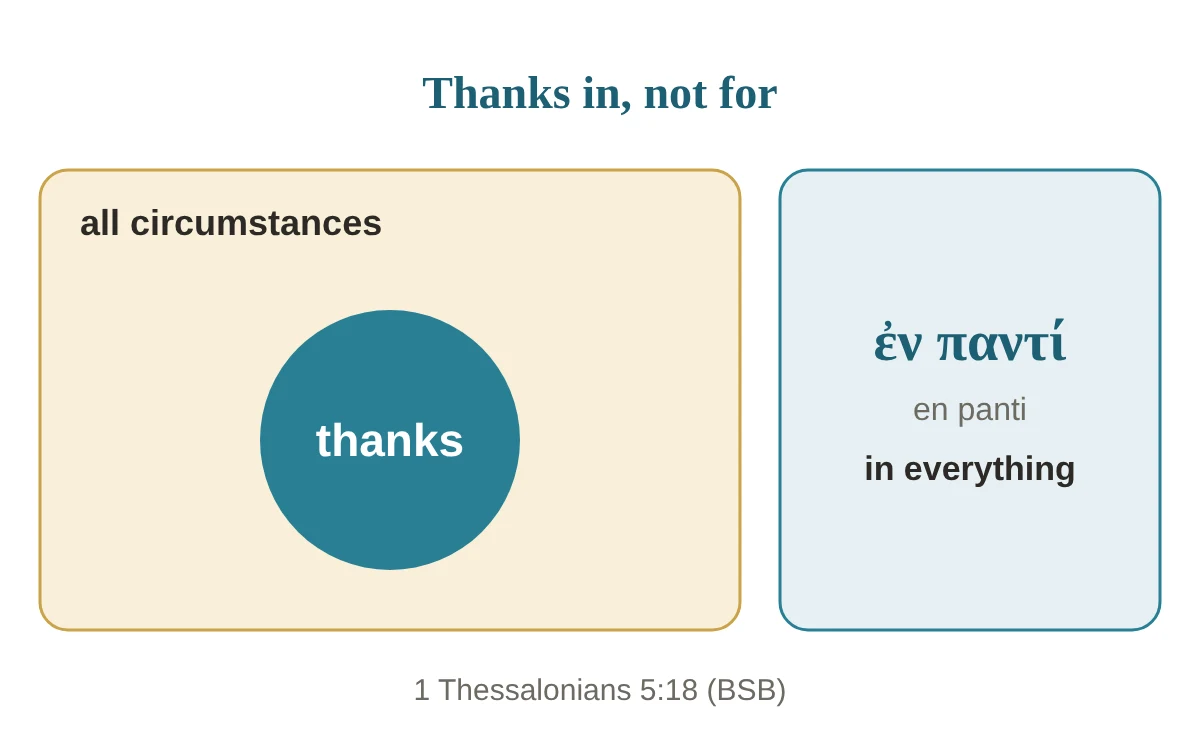
Verses 16-18 are among the most quoted in the New Testament: “Rejoice always! Pray without ceasing. Give thanks in all circumstances, for this is God’s will for you in Christ Jesus” (BSB). The word for “without ceasing” (adialeiptōs) describes something that keeps coming back without being abandoned, like a habit that never lapses, not wordless prayer every minute. The three commands interpret each other: always covers every time, and all circumstances covers every situation.
Notice that thanks is commanded “in” all circumstances, not “for” all circumstances. Paul is not asking anyone to call suffering good. He is asking that gratitude stay possible inside it. The single verse that expands on prayer is at 1 Thessalonians 5:17, and the wider theme is gathered in thanksgiving scriptures.
Try this: Pick one daily routine, such as the morning commute or washing dishes, and attach a one-sentence prayer to it for a week. The habit, not the length, is what verse 17 describes.
Test everything and the appearance of evil
Verses 19-22 move quickly: “Do not quench the Spirit” (v. 19, BSB). The Greek verb is used of putting out a fire. Then, “do not despise prophecies,” followed by “test all things” and “hold fast what is good.” Paul places enthusiasm and discernment side by side. The gifts are not to be suppressed, and they are not to be accepted unexamined. The sorting happens inside the community.
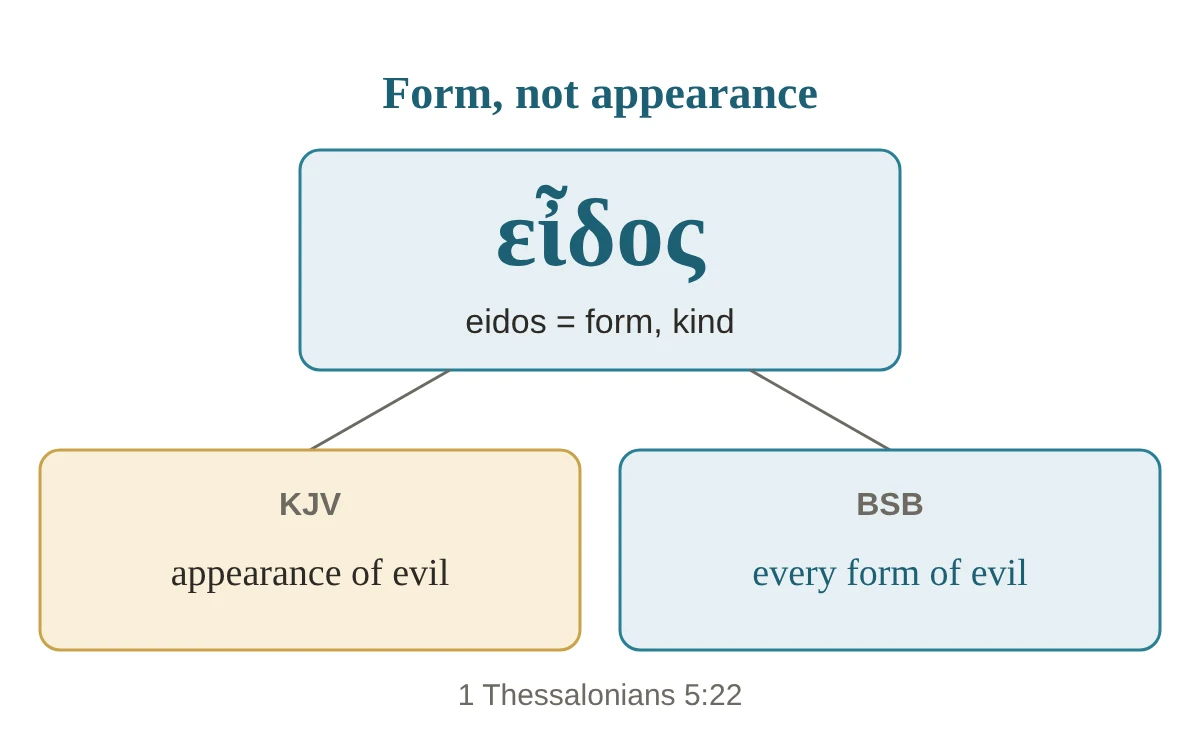
The KJV reads verse 22 as “Abstain from all appearance of evil” (KJV), which many have taken as a rule about avoiding anything that merely looks bad. The Greek eidos means a form or kind, so the BSB’s “every form of evil” is closer. The command is about the types of evil itself, not about managing reputation.
Spirit, soul and body (5:23-24)
The prayer in verse 23 is the high point of the letter: “May the God of peace Himself sanctify you through and through” (BSB), asking that “your whole spirit, soul, and body” be kept blameless at Christ’s coming. Two Greek words are stacked for “completely”: one points to being finished, the other to being intact, with nothing left out.
Some Christians treat the list as a three-part model of the person; others see it as a Hebrew-style way of saying the whole self, since Paul is praying, not writing psychology. Both groups agree on the main point, which is that sanctification is God’s work. Verse 24 says so directly: “The one who calls you is faithful, and He will do it” (BSB). The same confidence appears in Philippians 1:6.
Closing requests (5:25-28)
Paul asks for prayer for himself and his team, a reminder that the apostle depended on the church as much as they depended on him. The “holy kiss” in verse 26 was a normal greeting of the time, and the point is the warmth, not the gesture. In verse 27 he strongly charges them to read the letter aloud to all the brothers, an early sign that apostolic letters were meant for the whole assembly.
The benediction, “The grace of our Lord Jesus Christ be with you,” is short, but it is the final answer to the pressure of the whole chapter. Everything demanded in verses 12-22 is carried by grace, not self-effort.
Key themes
- Readiness, not speculation: the date is withheld, but the posture is clear.
- Light and darkness: identity shapes behavior.
- Mutual care: the end-time hope is lived out in ordinary church life.
- Spirit and discernment: gifts are welcomed and tested.
- God’s faithfulness: sanctification finishes because God completes it.
Key verses in 1 Thessalonians 5
- 5:2: the Day of the Lord comes like a thief in the night.
- 5:9: God appointed believers to salvation, not wrath.
- 5:11: encourage one another and build each other up.
- 5:16-18: rejoice always, pray without ceasing, give thanks in all circumstances.
- 5:21: test all things and hold fast to what is good.
- 5:23-24: God Himself sanctifies, and He is faithful to do it.
Each of these carries weight on its own, but they work best together: alertness (5:2), security (5:9), community (5:11), daily habits (5:16-18), discernment (5:21) and God’s promise (5:24).
How the chapter fits into the rest of Scripture
The chapter draws on the Old Testament’s Day of the Lord, which was a day of judgment on those who ignored God, and on Jesus’ own Olivet teaching. Paul compresses both into a single question: whether a person lives as if the day is coming. The result is neither fear nor curiosity, but steady readiness.
Read next to 2 Thessalonians, the chapter shows two sides of one pastoral concern. First Thessalonians calms people who feared they had missed something. The second letter corrects those who believed the day had already come. The common thread is calm, working faith.
Try this: Choose one command from verses 12-22 and treat it as the week’s assignment. Check back on it at the end of the week, and note what changed.
Common questions
What is the main message of 1 Thessalonians 5?
The chapter teaches that the Day of the Lord will arrive suddenly for a careless world, but believers belong to the day and are called to stay alert and steady. Paul then turns to practical community life and closes with a prayer that God Himself will keep them blameless.
What does 'pray without ceasing' mean in 1 Thessalonians 5:17?
The Greek word describes something that keeps recurring without being dropped, not speech with no pauses. Paired with 'rejoice always' and 'give thanks in all circumstances', it describes a life habitually turned toward God.
Does 1 Thessalonians 5:22 mean avoiding anything that looks bad?
The KJV phrase 'appearance of evil' has often been read that way, but the Greek word means a kind or form of something. Newer translations such as the BSB read it as abstaining from every form of evil.
Does 1 Thessalonians 5:23 teach that people have three parts?
Verse 23 names spirit, soul and body, and some Christians see three distinct parts here. Others read it as a rich way of saying the whole person, since Paul is praying, not outlining human anatomy.
What does 'a thief in the night' mean in 1 Thessalonians 5?
It describes the unexpected timing of Christ's return, not its character. Paul applies the surprise to those who say 'peace and safety', while believers who stay awake are not meant to be caught off guard.
When was 1 Thessalonians written?
Most scholars date it to about AD 50 or 51, written from Corinth, which makes it one of the earliest New Testament writings. It followed Paul's brief founding visit to Thessalonica recorded in Acts 17.