
What Does 3/3 Mean? Date, Bible Reference and Biblical Number
3/3 most often means March 3 when it appears as a date, and 3:3 (chapter 3, verse 3) when it appears as a Bible reference. As a fraction it equals one whole, and in a series it simply means “three of three.” The context decides which one applies, and for a Bible reader the reference meaning is usually the one that matters.
The date reading is the only one that never changes, because month-first and day-first writing agree on it. The Bible reading is richer than most people expect: at least eight books have a 3:3 that carries a surprising idea, from the odd word Eve adds in the garden to the verse that sets up the “born again” conversation. The sections below cover each meaning in turn.
Four things 3/3 can mean
A reader who meets “3/3” in a message, a bulletin, a reading plan or a search bar is normally facing one of four situations. Sorting them first saves time.
- A date: March 3 (or 3 March).
- A Bible reference: the third verse of the third chapter, usually written 3:3.
- A fraction or score: three thirds, or three out of three.
- A symbol: the number three, sometimes repeated as 333 and treated as a “sign.”
Each has its own history. The date has a Hebrew-calendar counterpart that few people know about. The Bible reference has a long list of verses behind it. The fraction has a notable counterpart in how Scripture describes partial judgment. The symbolic reading has a real biblical basis in the number three but a weak one in the idea of numbers as messages. Each is handled below.
3/3 as a date: March 3 or 3 March
In the United States 3/3 is read month-first, so it is March 3. In most of Europe, Latin America, Africa, Asia and Oceania the order is day-first, and 3/3 is read as 3 March. Both give the same day, which makes 3/3 one of the few dates that no format can scramble. Only the odd years-and-months formats (such as January of the year 3) produce something different, and those are rare outside of data tables.
March 3 sits in the stretch of the year where Lent often falls in Western churches. In 2027, for example, Ash Wednesday is on February 10 and Easter on March 28, so March 3 lands in Lent. The date also appears on some church calendars: in the U.S. Catholic calendar it is an optional memorial of Katharine Drexel, who founded a religious order to serve Native American and African American communities.
Nothing in Scripture assigns a meaning to March 3 itself. The Bible never uses the Roman calendar, which is a later system, so a date like this has no verse attached. What the Bible does have is a third day of a third month, which is a different calendar entirely.
The third day of the third month in the Hebrew calendar
The biblical year is counted from Nisan, the month of the Passover (Exodus 12:2). That makes Sivan the third month. Exodus 19:1 places Israel at Mount Sinai in “the third month,” and in verse 11 God tells Moses that the people must be ready “against the third day.” Jewish tradition builds on this by treating the third of Sivan as the start of three days of preparation and boundaries before the giving of the Law, which is celebrated at Shavuot (Pentecost) on the sixth.
So a Hebrew 3/3 is a day of getting ready, and the idea is worth noticing. The Law at Sinai was not given on the day Israel arrived. There was a short, deliberate gap of washing, waiting and limits. The commandments that follow, in Exodus 20:12-20 and the verses around it, arrive after that gap.
This Hebrew-calendar reading is a tradition of interpretation. The text itself only gives “third month” and “third day,” and Jewish sources differ slightly on the exact dating of the Sinai events. It is a useful angle for anyone who sees 3/3 and wants a biblical echo of the date.
How to read 3/3 as a Bible reference
Standard Bible references put a colon between chapter and verse, so 3:3 means chapter 3, verse 3. Some European styles use a comma (Gen 3,3), and a slash like 3/3 is a casual way of typing the same thing. Without a book name the reference is incomplete: nearly every book with three or more chapters has a verse 3:3, and each says something different. The single-chapter books such as Jude have no chapter 3 at all.
There is one genuine curiosity. The short letter of 3 John has only one chapter, so “3 John 3” reads as the third book’s third verse: “I rejoiced greatly” (KJV), the elder says, when believers came and testified to the truth in Gaius. It is the only place in the Bible where the book number, the chapter and the verse all line up on a three.
Readers who want to track how one passage echoes another will find that many of the 3:3 verses below talk to each other. The habit of following those links is the basis of cross references in the Bible.
Genesis 3:3 and the word “touch”
Genesis 3:3 is Eve’s reply to the serpent. In the KJV she says that God has said of the tree in the middle of the garden, “neither shall ye touch it, lest ye die.” The original command in Genesis 2:17 forbids eating and says nothing about touching. The extra clause is the first place where the account of the Fall seems to shift.
Interpreters read this differently. A line of Jewish interpretation, preserved in Avot de-Rabbi Nathan, takes the added word as Eve building a “fence” around the command, a protective extra that backfired when she touched the fruit and survived, which made the serpent’s denial sound more believable. The Mishnah (Avot 1:1) praises fence-building around the Law, so the tradition is mixed about whether the addition is a mistake or a precaution. Other readers point out that Eve may have heard the command from Adam, since it was given before she was created, and that the paraphrase is natural.
The practical lesson survives either way. Adding to what God has said, even with good motives, can leave a gap that the tempter exploits. The serpent’s reply in verse 4, “You will not surely die,” attacks the exaggerated version first.
John 3:3: born again or born from above
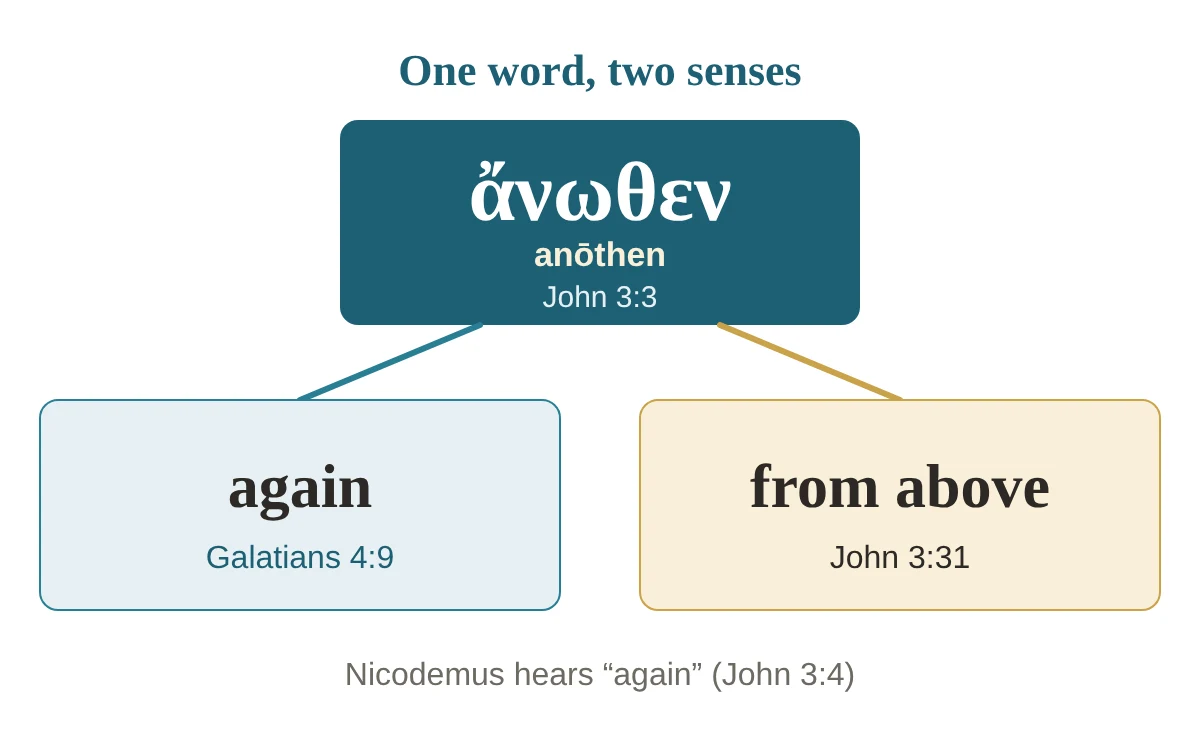
In John 3:3 Jesus tells Nicodemus, in the BSB, “Truly, truly, I tell you, no one can see the kingdom of God unless he is born again.” The Greek adverb here is anōthen, which can mean “again” or “from above.” John uses it elsewhere with the “from above” sense (as in John 3:31 and 19:11), and Nicodemus clearly hears “again,” since his next question is how a man can enter his mother’s womb a second time.
The double meaning is probably deliberate. Jesus speaks of a new birth that is also a birth from God, and the conversation continues in verse 5 with water and Spirit. Churches differ on the details. Many Protestant traditions connect the new birth with personal faith, Catholic, Orthodox and some Lutheran and Anglican traditions connect “water” with baptism, and others see water as a picture of the Spirit’s cleansing, as in Ezekiel 36:25-27. Most Bible translations keep “born again” and note “from above” in the margin.
The verse is the doorway to the most quoted sentence in the Gospel, John 3:16, which Jesus speaks in the same night-time conversation. The “Truly, truly” opening (the Hebrew-sounding “amen, amen”) is a feature of John’s Gospel and marks a statement Jesus wants taken as solid.
Proverbs 3:3 and Colossians 3:3: heart and hiddenness
Proverbs 3:3 (KJV) says, “Let not mercy and truth forsake thee.” The Hebrew words are chesed and emet: covenant loyalty and reliability. The pair appears together often in the Old Testament as a description of God’s own character, so the father in Proverbs is asking his son to carry God’s traits. The verse then says to bind them about the neck and write them “upon the table of thine heart.” The picture draws on the commands in Deuteronomy 6 to bind God’s words on the hand, and it moves the writing surface from the body to the inner life.
That image returns in 2 Corinthians 3:3, another 3:3. Paul tells the Corinthians they are a letter from Christ, written “not in tables of stone, but in fleshy tables of the heart” (KJV). He reads the old proverb through the promise of Jeremiah 31:33 that God would write his law on hearts. Two verses with the same number end up describing one idea.
Colossians 3:3 (KJV) goes in a different direction: “your life is hid with Christ in God.” The word “hid” matters because Colossians has just argued against teachers who claimed secret, special wisdom for a few. Paul reverses that. The hidden thing is the believer’s life itself, kept safe in Christ, and it is not a private knowledge for an elite.
Try this: Read Proverbs 3:1-4 slowly, then write two words on a card, one for loyalty and one for truthfulness. Place it where it will meet your eyes tomorrow, and note one conversation where each word will be tested.
Revelation 3:3 and the city that was caught asleep
In Revelation 3:3 Jesus addresses the church in Sardis: “I will come on thee as a thief” (KJV) unless the church wakes up and remembers what it received. The city had a particular history behind this. Its high, steep acropolis was thought to be impregnable, yet ancient historians record that it fell twice, to Cyrus and later to Antiochus III, when guards failed to watch a cliff face. The church was told it had a reputation for being alive while being dead, and the warning used the very image of the unguarded city.
The “thief” phrase is not a threat in every use. In 1 Thessalonians 5 the same image describes the Day of the Lord arriving unexpectedly for the careless, while believers are told they are not in darkness. In Sardis the problem was drowsiness, and the remedy was three verbs: remember, keep, repent.
The next verses of the chapter show how quickly the tone turns. A few believers in Sardis had not soiled their clothes, and the chapter closes at Laodicea with the famous knock at the door in Revelation 3:20. Reading the verse alongside its chapter keeps the warning in proportion.
Other 3:3 verses worth knowing
Several more 3:3 verses reward a closer look, and each opens onto a different theme.
- Exodus 3:3: Moses says, “I will now turn aside, and see this great sight” (KJV). God speaks from the bush only after he sees that Moses has turned aside, so attention comes first.
- Matthew 3:3: John the Baptist is introduced with the words of Isaiah 40:3, “Prepare ye the way of the Lord” (KJV). The Gospel treats the quotation as a claim about who Jesus is.
- 1 Corinthians 3:3: Paul tells the church, “ye are yet carnal” (KJV), because envy and quarrels divide them. It is a rebuke to a gifted but quarrelsome congregation.
- Titus 3:3: Paul lists the old life of believers: foolish, disobedient, led astray. One commentator counts seven commands in verses 1 and 2 and seven vices here, as a deliberate contrast.
- 1 John 3:3: “every man that hath this hope in him purifieth himself” (KJV). Hope in Christ’s appearing is described as something that shapes present conduct.
A related verse that is often confused with these is Matthew 6:3, about not letting the left hand know what the right hand does. It is not a 3:3, but it is the one that shows up when people search for “3 3” and the Sermon on the Mount.
Why Psalm 3:3 is sometimes Psalm 3:4
Psalm 3:3 in English reads, in the KJV, “thou, O LORD, art a shield for me.” In many Hebrew Bibles, and in some translations that follow them, the same sentence is verse 4. The reason is that the Hebrew text counts the title line (“A Psalm of David, when he fled from Absalom his son”) as verse 1, while most English Bibles leave the title unnumbered.
This affects dozens of psalms and explains why a commentary and a Bible app may seem a verse apart. Catholic and Orthodox Bibles that follow the Greek Septuagint and the Latin Vulgate add another layer, because their Psalm numbers differ from the Hebrew for much of the book (Psalm 23 in English is Psalm 22 in those traditions). When a reference seems to miss the mark by a verse or a chapter, check which numbering the source uses before concluding that it is wrong.
The setting of Psalm 3 is worth a note. David wrote it while fleeing his son Absalom, so the “shield” of verse 3 comes from a man with every earthly reason to feel exposed. Verse 5 has him lying down and waking safely. The psalm is also read as a morning prayer in several traditions, and Psalm 3:7 continues the cry for deliverance.
3/3 as a fraction: the whole, and the third
Mathematically 3/3 is one, a complete whole. Scripture has an interesting habit that runs the other way: it often speaks of a third as a limit. In Ezekiel 5:12 a third of the city dies by plague, a third falls by the sword and a third is scattered. In Zechariah 13:8-9 two parts are cut off and a third is left, to be refined like silver. In Revelation 8 the first four trumpets strike a third of the earth, trees, sea and sky.
The pattern in Revelation is clear. The trumpets are partial, warning judgments, and the bowls of chapter 16 carry no such limit. The fractions work like a measured alarm before something final, which is how many interpreters read the sequence, though views on how to read the trumpets differ widely among premillennial, amillennial and other readers. A closer look at the sequence is in the page on the 7 trumpets.
Zechariah’s image is the hopeful one. The remaining third is not abandoned: “They will call on My name and I will answer,” the passage continues in its own words. A third in Scripture is often a remnant, and a remnant is what God works from.
What the number three carries in Scripture
Three matters in the Bible, though not as a code. The resurrection happens on the third day, which Paul says was “according to the Scriptures” (1 Corinthians 15:4, BSB), pointing back to texts like Hosea 6:2 and the sign of Jonah. Peter denied Jesus three times, and John 21 has Jesus ask Peter three times if he loves him, a restoration that mirrors the failure. Paul asked the Lord three times about his thorn in the flesh, a story in 2 Corinthians 12.
Worship uses three too. Isaiah hears the seraphim cry “Holy, holy, holy” (Isaiah 6:3, KJV), the only place in the Bible where an attribute of God is repeated three times as a superlative. The priestly blessing is built in three lines of three, five and seven words in Hebrew, a shape found in Numbers 6:24. Ecclesiastes 4:12 says a threefold cord is not quickly broken.
Christians also see three in the doctrine of the Trinity. Jesus commands baptism “in the name of the Father and of the Son and of the Holy Spirit” (Matthew 28:19, BSB), with one name for three persons. The verse is the clearest single-sentence pointer to the doctrine in the New Testament, and it is covered in Matthew 28:19. Scholars caution against reading every three as a symbol, since many threes in the Bible are just three.
Angel numbers and signs
Popular spiritual culture treats repeated numbers such as 333 or dates like 3/3 as messages from angels or the universe. The Bible does not teach this. Scripture does record angels delivering messages, but always with words, names and clear content (Luke 1 is the model), and it warns against seeking guidance through divination (Deuteronomy 18:10-12).
Christian traditions differ in tone here. Some treat angel numbers as harmless coincidence, others as a form of fortune-telling to avoid, and many simply do not engage the idea. What nearly all agree on is that guidance in Scripture comes through the written Word, prayer, wise counsel and the Spirit, not through patterns on a clock.
A noticing habit can still be put to good use. If a date or number brings a verse to mind, the honest step is to open the verse and read it in context. The prompt is the number, and the content is the passage. This keeps attention on what God has said rather than on what a number might hint.
Try this: The next time 3/3 or 3:33 catches your eye, stop and read one 3:3 verse from the list above in full, including the verses on either side. Write one sentence about what it says before you decide what it “means.”
When 3/3 simply means three of three
In ordinary use 3/3 often just means “three out of three”: a completed series, a perfect quiz score, the last part of a three-part message, or the third day of a three-day reading plan. Bible reading plans, study series and sermon sets are commonly labeled this way, and the meaning is plain.
It is still worth noticing how the Bible itself finishes threes. The third day is when things are resolved: Abraham’s trip to Moriah ends when he lifts his eyes on the third day (Genesis 22:4), Jonah is released on the third day, and Jesus rises on it. The third element of a sequence is often where the story turns.
For anyone running a short Bible study, a three-part plan is a good size. Part three can be assigned to the question “what do I do about it?” so the series ends in action. The page on Bible study articles collects approaches that follow this shape.
How to find the meaning of the 3/3 in front of you
The quickest way to decide what a particular 3/3 means is to look at where it appeared. A few checks settle most cases.
- Is there a book name nearby? If so, it is a verse reference, and the book tells you which 3:3.
- Is it in a message with a date or time? Then it is March 3, or the third of a three-part set.
- Is it a number someone thinks is a “sign”? Treat it as a prompt to read Scripture, not as a message.
- Is it in a Psalm? Check the numbering of the Bible being used.
A bare 3/3 with no book name usually cannot be a Bible verse, since the reference would be incomplete. A good habit is to ask the person who wrote it what they meant, and to treat any answer that starts with a number rather than a passage with some care.
Try this: Pick one of the 3:3 verses in this article that you have never read in its chapter. Read the whole chapter in one sitting and underline the sentence that explains why verse 3 matters.
For further reading in the same spirit, the Bible verses by topic pages group passages by theme, which is a useful next step after following a single reference.
Common questions
What does 3/3 mean as a date?
It means March 3. In the American month-first format and the day-first format used in most of the world, 3/3 gives the same date, so it is never ambiguous.
What does 3/3 mean in the Bible?
Written as 3:3, it points to the third verse of the third chapter of a book. Well-known examples are Genesis 3:3, John 3:3, Proverbs 3:3, Colossians 3:3 and Revelation 3:3, and each says something different.
Does 3/3 or 333 have a spiritual meaning in the Bible?
The Bible gives no teaching about repeating number patterns as messages. The number three does matter in Scripture, in the third day of resurrection and the threefold holiness of God, but that is a matter of what the text says and not of numbers seen on a clock or calendar.
What is the most famous 3:3 verse?
John 3:3 is the best known, where Jesus tells Nicodemus that no one can see the kingdom of God unless he is born again. The Greek word behind "again" can also mean "from above."
What does 3/3 mean as a fraction?
Three thirds equals one whole. In Scripture the opposite idea is more common: judgments that strike only a third, as in Ezekiel 5, Zechariah 13 and the trumpets of Revelation 8.
Why does a verse like Psalm 3:3 sometimes appear as 3:4?
Many Hebrew Bibles count the psalm's title line as verse 1, which pushes every later verse up by one number. English Bibles usually treat the title as unnumbered, so the same sentence gets a different reference.