
Night Prayer: What Scripture Teaches and How to Pray It
Night prayer is the prayer a Christian says at the close of the day, before sleep or during the hours of darkness. Scripture gives it a clear shape: thanks for the day, honest speech about what is unresolved, and a handing over of the night into God’s care. The Church’s oldest form of it is called Compline, but a few sincere sentences at the bedside serve the same purpose.
Most pages on this topic give a list of bedtime prayers and little else. The Bible has far more to say about the night than that: why Israel’s day began at dusk, what the “night watches” were, what one small Hebrew word does to Psalm 4:8, and why Jesus spent whole nights praying. Four original prayers appear further down, with guidance on how to use them.
Why the Bible’s day begins at night
Genesis 1 repeats a pattern six times. In the KJV it reads, “And the evening and the morning were the first day.” Evening comes first. In Hebrew thinking the day starts at sundown, which is why the Sabbath begins on Friday evening and why Jewish households still count festivals from dusk. Night is not the end of the day’s work. It is where the new day starts, and God is already working in it.
That changes what night prayer means. It is less a closing of accounts than a handing over: the day is finished, and what happens in the dark belongs to God before it belongs to anyone’s effort. Genesis pictures creation as something done while the world was still unformed and dark.
Jewish practice made this concrete. The bedtime Shema (the “Shema al hamitah”) grew from Deuteronomy 6:7, which tells Israel to speak of God’s words “when thou liest down, and when thou risest up” (KJV). Early Christians inherited the same instinct. Hippolytus, in the Apostolic Tradition, taught prayer on rising, at bedtime and at midnight, among other hours, as part of seven daily prayer times.
The night watches and what they were for
The Old Testament divides the night into three watches (a watch was a shift for the city guards). Judges 7:19 mentions the middle watch, and Exodus 14:24 describes God acting in the morning watch at the Red Sea. By the New Testament the Roman system of four watches was in use, which is why Mark 13:35 lists evening, midnight, cockcrow and morning. Matthew 14:25 places Jesus walking to his disciples on the sea in the fourth watch, the hour just before dawn.
Psalm 63:6 (KJV) speaks of meditating on God “in the night watches,” and Psalm 119:148 describes eyes that stay open through them to ponder God’s word. Lamentations 2:19 goes further and tells the sufferer to cry out in the night, “in the beginning of the watches,” pouring the heart out like water. The night in these texts is a place where grief and attention both get louder, and Scripture sends both toward God.
One line from Psalm 30:5 is worth a second look. The KJV says weeping “may endure for a night.” The Hebrew verb behind “endure” is closer to lodging overnight as a guest. Sorrow is pictured as a visitor who stays for the night and is gone by morning, not a resident who owns the house.
Psalm 4:8 and the Hebrew behind dwelling in safety
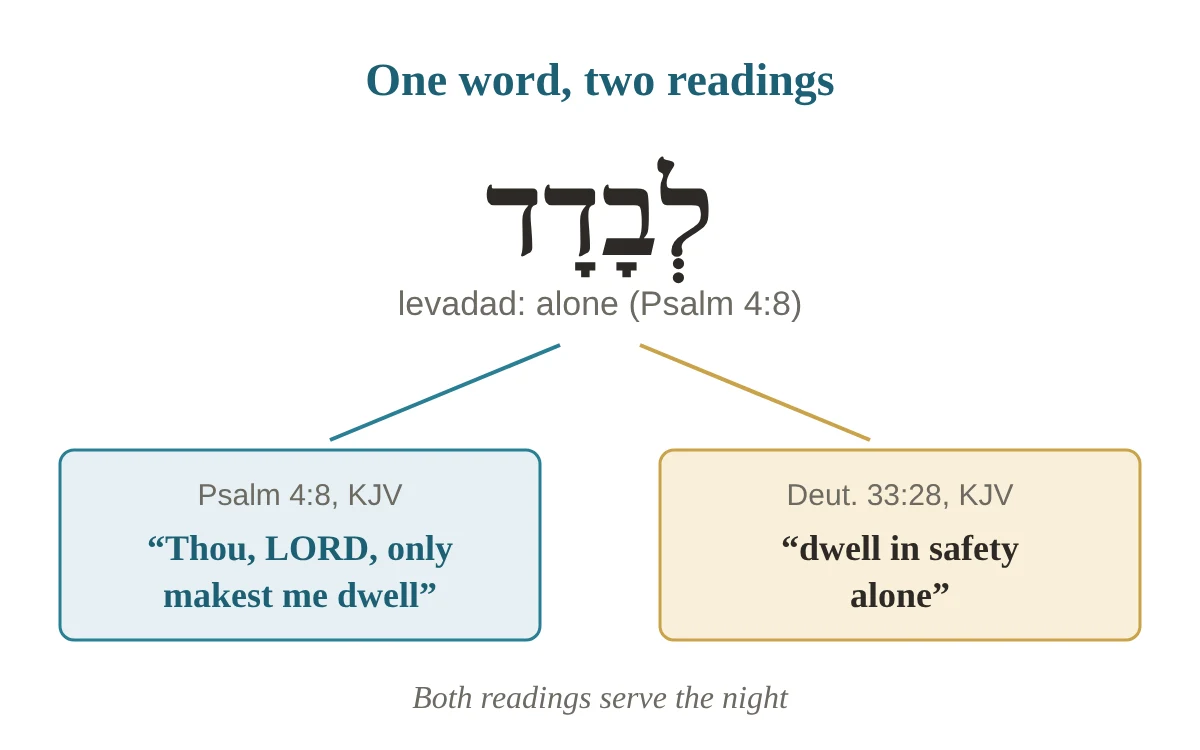
The verse most often prayed at night is Psalm 4:8. The KJV reads, “I will both lay me down in peace, and sleep.” The psalm is often called an evening psalm, partly because verse 4 says, “commune with your own heart upon your bed, and be still” (KJV). It was written by someone under pressure, with critics and a shaken reputation, and it ends in sleep, not in solved problems.
The last line holds a small puzzle. In Hebrew, the word levadad (alone) sits in the sentence in a position that allows two readings. It can mean “you alone, Lord, make me dwell in safety,” which is how most English Bibles translate it. It can also mean “you make me dwell alone in safety,” a phrase that matches Deuteronomy 33:28, where Israel dwells safely alone. Both readings serve the night. One says God is the only guard that counts, and the other says a person can be safe even when no one else is in the room.
The word for “safety” (betach) means confidence, not just absence of danger. The psalmist does not say the threats are gone. The psalmist says the heart can lie down anyway.
Try this: Read Psalm 4 aloud once, slowly, then stop at verse 4 and sit silent for one minute before reading verse 8. Notice what the silence makes room for.
Sleep as a gift in Psalm 127:2
Psalm 127:2 is often quoted in the KJV as “for so he giveth his beloved sleep.” Context matters. The verse begins by calling it vain to rise early, stay up late and eat “the bread of sorrows,” meaning bread earned by anxious toil. The Hebrew of the last line can be read two ways: God gives sleep to his beloved, or God gives to his beloved while they sleep. Translators differ, and the second reading adds something the first lacks: God keeps working while the person is unconscious.
This verse is not a rebuke of hard work, and it is not a promise that faithful people will never have a bad night. It sits in a psalm about the house that only God builds. The point is that the builder does not need the worker’s insomnia. Psalm 131, where the soul is quieted like a weaned child, is a natural companion to it.
The Gospels give a picture of the same idea. In Mark 4:38, in a storm bad enough to frighten experienced fishermen, Jesus is asleep on a cushion in the stern. The disciples read his sleep as indifference. The rest of the story treats it as the calm of someone who knows who holds the boat.
What Jesus did with his nights
Luke 6:12 says that before choosing the twelve apostles Jesus went out to a mountain and “continued all night in prayer to God” (KJV). The greatest decision of his early ministry was preceded by a night, not a meeting. The Greek word used for “all night” appears only here in the New Testament, which marks it as unusual even for the Gospel writers.
His last night before the cross shows the other side. In Gethsemane (Matthew 26:40 to 41) he asks the disciples to watch and pray with him, and they fall asleep. The same Gospel that praises sleep as a gift also records a night when staying awake was the kinder thing. Neither is a rule. Night prayer is responsive to what the night actually contains.
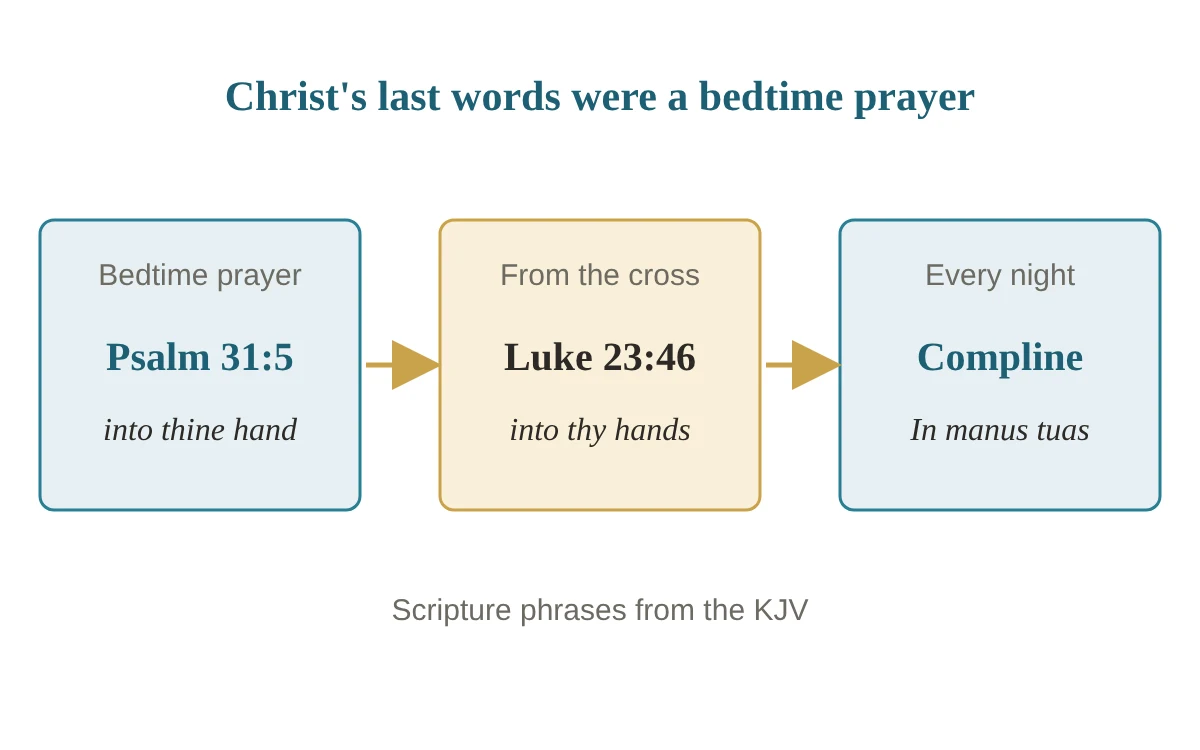
His final words on the cross, “Father, into thy hands I commend my spirit” (Luke 23:46, KJV), quote Psalm 31:5. In Jewish households that psalm verse was already a bedtime prayer. It became the hinge of Compline for the same reason: the responsory at the heart of Compline comes from Psalm 31:5, and Christ said it from the cross.
Paul and Silas, and prayer at midnight
Acts 16:25 (KJV) says, “at midnight Paul and Silas prayed, and sang praises unto God: and the prisoners heard them.” They had been beaten and fastened in stocks in the inner cell of the Philippian jail. Nothing in the text suggests they felt cheerful. The prayer is notable because it is audible: the other prisoners were listening, which means the night prayer of two hurting men became a witness to strangers.
Psalm 119:62 (KJV) has the same instinct: “At midnight I will rise to give thanks unto thee.” The reason given is God’s righteous judgments, not a good night’s rest or a good day behind. Praise at midnight is praise that does not need the circumstances to improve first.
Neither passage commands midnight prayer, and care is needed here. They record what believers did when the hours were dark. The earliest Christian writers turned that into a custom: Cyprian wrote that prayers should not fail in the hours of night, and the habit spread from there.
Compline, the church’s goodnight prayer
Compline is the formal night prayer of the Church. The name comes from the Latin completorium, meaning completion, and the office appears to have begun in the monasteries around the fourth century as bedtime prayer for the monks. St. Benedict’s Rule fixed its place in the sixth century. After Compline, many monasteries kept the “Great Silence” through the night, so that no one spoke between the last prayer and the next day.
A typical Compline service has these parts:
- A short examination of the day and a confession
- A hymn, traditionally Te lucis ante terminum (“Before the ending of the day”)
- Psalms of trust, usually Psalm 4, Psalm 91 and Psalm 134
- A short reading and the Compline responsory from Psalm 31:5
- The Song of Simeon (Luke 2:29 to 32), then a closing prayer
Traditions vary. Roman Catholics pray it as the last hour of the Liturgy of the Hours. Anglicans received it late: it entered the Episcopal Church’s prayer book in 1979 and the ACNA’s in 2019, though the Evening Prayer collect “Lighten our darkness, we beseech thee, O Lord; and by thy great mercy defend us from all perils and dangers of this night” (BCP, public domain) has long served the same role. Lutherans keep a Compline form in their service books, and the Orthodox have Small and Great Compline. Many Protestants have no fixed form at all and pray in their own words. Both patterns have scriptural footing.
“Now I lay me down to sleep” and its history
The best-known night prayer in English is the child’s verse beginning “Now I lay me down to sleep.” Versions of it appear in print by the 1700s in New England primers, and it has older roots in English devotional manuals. It borrows the Compline idea of committing the soul to God for the night in simple rhymed form.
The third line, about dying before waking, has made some parents hesitate. The reading behind it is not morbid. Sleep was long understood as a small rehearsal of death, and the Church’s Compline texts ask for a peaceful end in the same breath as a peaceful night. Psalm 4:8 says as much by pairing lying down with safety. For children who are anxious, many families adjust the wording to something like “keep me safe till morning light,” which keeps the trust and drops the fear.
The related English verse about four corners to the bed, with angels at each, is a folk charm of uncertain age. It has no direct biblical text behind it, though Psalm 91:11 does speak of angels given charge over the faithful, and Hebrews 1:14 calls them ministering spirits.
A simple order for praying at night
A good night prayer does not need to be long. Four movements, borrowed from the structure of Compline, give any set of words a spine:
- Thank God for specific things from the day, even small ones.
- Name what went wrong, including anything that needs forgiving or apologizing for tomorrow.
- Hand over what is unfinished. Say the names and tasks aloud if it helps.
- Close with a line of trust, such as Psalm 4:8 or Luke 23:46.
The second step has a biblical edge. Ephesians 4:26 (KJV) says, “let not the sun go down upon your wrath.” That verse is about the evening, and it makes night prayer the natural moment to settle anger rather than carry it to bed. The third step follows 1 Peter 5:7, which describes casting anxieties on God, with the picture of a person throwing a load off their back, not carefully placing it down.
Try this: Tonight, finish the prayer by saying one thing out loud that you are leaving with God until morning. Name it specifically, such as “the meeting on Thursday.” Naming it is what lets it go.
A prayer to close the day
This prayer follows the order above and takes about a minute. It works kneeling, sitting on the edge of the bed or lying down.
Lord God, the day is done, and I am glad it was yours. Thank you for the things I noticed and the things I did not. Forgive me for the words I should have held back and the kindnesses I skipped. I ask for the grace to put right what I can tomorrow. What I started and could not finish, I leave in your hands. What I cannot fix, I give to you by name. Keep my sleep, and keep those I love. Into your hands I commit my spirit. Amen.
To pray it well, pause after each sentence long enough to mean it. If a particular person or event comes to mind, stay with it for a few breaths before moving on. The last line is Luke 23:46, so the prayer ends in the same words that have closed Christian days for sixteen centuries.
A prayer for a restless mind
Anxiety at night is common and well documented in Scripture. Psalm 94:19 (KJV) says, “In the multitude of my thoughts within me thy comforts delight my soul.” The verse does not say the thoughts stop. It says comfort arrives inside the multitude.
Father, my mind will not settle, and I would rather tell you than pretend. These are the things going round: (name them). I cannot solve them tonight, and I do not have to. You were awake before I was born and you will be awake while I sleep. Take the weight of these thoughts. Where I need to act, show me in the morning. Where I need to wait, teach me how. Quiet me as you quieted the sea. Let your peace stand guard over my heart. Amen.
The names matter. A worry spoken in general terms tends to stay general and keep circling. A worry named exactly can be handed over and then, mostly, left there. If the thoughts return, repeat only the last sentence. The prayer is meant to be used more than once in a night if needed.
A prayer for those awake tonight
Traditional Compline includes a petition for people who work, watch or weep through the night. The thought is that the one praying is only one of many who are awake, and that sleep is a privilege not everyone has.
Lord Jesus, you know the night shift and the hospital corridor. Be near the nurse on her feet, the driver on the long road, the mother with a sick child, the man who sits alone with grief. Give strength to those who guard, patience to those who wait, and rest to those who finally can. Keep watch where I cannot. Let morning find them held, and find me ready to be of use to someone tomorrow. Amen.
This is a prayer to pray slowly and to adapt. Replace the examples with people actually known: a friend on a ward, a family member working a late shift, a neighbor who lost someone this week. Praying for specific people is also a first step toward doing something for them the next day.
A short prayer for home and family
For nights when words are few, or when a child is in the room, a short prayer will do.
God of the whole house, thank you for today. Guard everyone who sleeps under this roof and everyone we love who sleeps somewhere else. Forgive our sharp words and mend what we broke. Keep fear out of the dark and peace in it. Let us wake rested and kind. Amen.
Families often say it together, one line each, or have each person add a name. A household that prays this way is doing something close to what Joshua 24:15 describes: deciding as a house whom it will serve. The prayer can also be read alongside a protection prayer when someone in the house is particularly afraid of the night.
When waking in the night
Waking at 2 or 3 in the morning is common, and it has a history. Historians of sleep, notably Roger Ekirch, have found that many people in pre-industrial Europe described a “first sleep” and a “second sleep” with a quiet waking period between. Some prayer manuals of the time included prayers specifically for those hours. The idea that wakefulness at night is a failure is relatively modern.
Scripture is honest about it. Psalm 77:4 (KJV) says, “Thou holdest mine eyes waking.” The psalmist is exhausted and cannot speak, and yet the next verses turn toward remembering God’s past works. Psalm 63:6 describes remembering God “upon my bed.” In both, the sleepless hour becomes a place where memory of God’s faithfulness can do some work.
A practical approach is to avoid solving problems and instead hold one short line. “Lord, you are here” or the response “Into your hands” can be repeated slowly with each breath. Praying does not have to keep anyone awake, and it does not have to put them to sleep either. It only needs to be honest.
Try this: Keep a small notepad by the bed. If a task or worry pops up at night, write one line, then pray, “This is yours until morning.” Many people find the page holds the thought so the mind does not have to.
Common misreadings of night prayer promises
Some verses are used at night in ways their authors did not intend. A few are worth correcting, because the misreading can leave a person disappointed rather than comforted.
- Psalm 91:5 says “thou shalt not be afraid for the terror by night” (KJV). It is not a guarantee that harm will never come. The psalm itself was quoted by the devil to Jesus in the wilderness (Matthew 4:6), a warning that it can be abused as a charm. It describes a refuge, not an immunity.
- Psalm 127:2 does not promise good sleep to the faithful. A person with chronic insomnia is not less beloved. The verse is about releasing anxious striving.
- “If I die before I wake” is not a doubt about God’s goodness. It is an honest acknowledgment of mortality, and many readers find it more comforting than it first sounds.
- Night prayer is not a performance. Jesus warns in Matthew 6:6 against praying to be seen, and the bedroom is exactly the “closet” he describes.
What night prayer does offer is steadier than a charm. Lamentations 3:22 to 23 says God’s mercies are new every morning, which means every night ends with a morning that already has mercy in it. The prayer is not an attempt to earn that. It is a decision to lie down inside it.
Common questions
What is a good short night prayer?
A classic one is the Compline response from Psalm 31:5: "Into thy hands I commend my spirit." Jesus prayed these words on the cross, and Christians have used them at bedtime for centuries. Prayed slowly, it covers thanks, release and trust in a single breath.
What is the difference between night prayer and Compline?
Night prayer is any prayer said at the end of the day. Compline is the fixed, liturgical form of night prayer used in Catholic, Anglican, Lutheran and Orthodox churches, with set psalms, a short reading and the Song of Simeon.
Which Bible verses are best for night prayer?
Psalm 4:8, Psalm 91, Psalm 134, Psalm 127:2 and Psalm 3:5 are the most used. Luke 2:29 to 32 (the Song of Simeon) and Luke 23:46 are also traditional closing words for the day.
Is it a sin to fall asleep while praying?
No. Scripture treats sleep as a gift from God (Psalm 127:2), and Jesus himself slept in a boat during a storm. Falling asleep mid-prayer is often described by Christian writers as resting in God's care, not as failure.
Does the Bible say to pray at midnight?
Psalm 119:62 speaks of rising at midnight to give thanks, and Paul and Silas prayed and sang at midnight in prison (Acts 16:25). These are examples, not commands. Early Christian writers later encouraged night prayer, but no verse requires it.
What should I pray when I cannot sleep?
Pray the worry itself, in plain words, then hand it over. Psalm 63:6 and Psalm 77 both show people turning wakeful hours into prayer. A short repeated line, such as "Lord, you are here," works better than trying to think through every concern.